
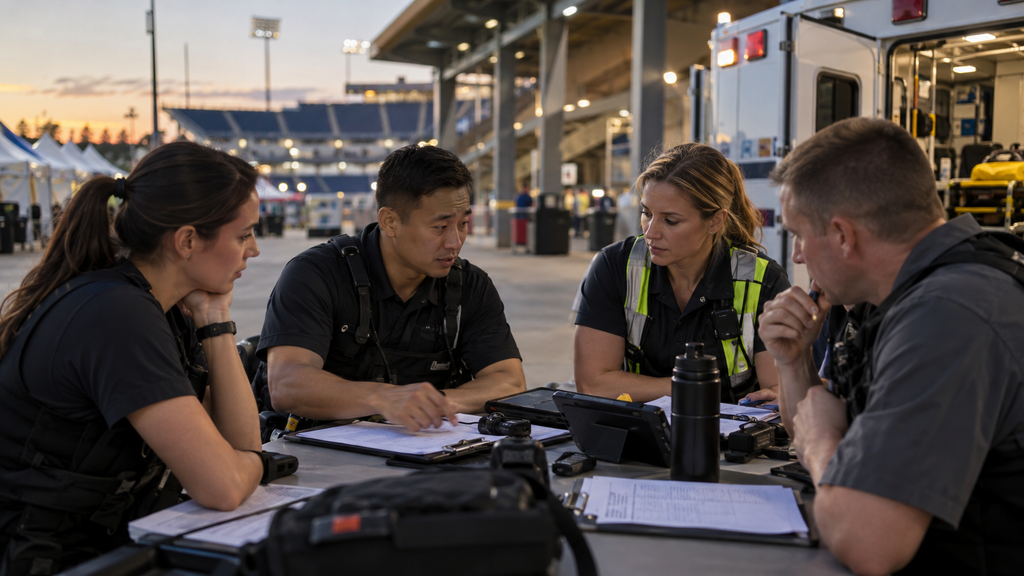
A quiet finish can hide a weak medical plan. The crowd may leave, the final patient may be transported without incident, and the event may still have exposed problems that would become serious under slightly higher demand.
The useful question after a major event is not simply whether anything went wrong. It is whether the medical operation matched the event that actually occurred. Where did the patients present? When did demand peak? Which roles were overloaded? Did an ambulance departure leave a coverage gap? Were medical teams easy to activate and reach? Did supplies, documentation, communications, and handoffs hold up under real conditions?
StaffDash already has an event medical staffing checklist for the planning stage. This article begins after operations end. Its purpose is to turn real event data into a better staffing and coverage decision for the next event.
| DIRECT ANSWERAn event medical after action review should compare the original medical plan with actual attendance, conditions, patient encounters, presentation patterns, hospital transfers, staffing use, ambulance availability, response barriers, communications, supplies, documentation, near misses, and unresolved problems. Every material finding should end with a corrective action, an owner, a completion date, and a method for confirming the change before the next event. |
|---|
Rebuild the Event as It Actually Happened
A plan is built on assumptions. The review should start by checking which of those assumptions were still true once the event was underway.
Record actual attendance, operating hours, weather, crowd density, schedule changes, venue access restrictions, alcohol or substance exposure where relevant, activity level, production changes, transport constraints, and changes in nearby Emergency Medical Services capacity. If the plan expected eight thousand attendees and twelve thousand arrived, the medical team should not be judged as though the original demand forecast remained accurate.
The Centers for Disease Control and Prevention notes that mass gathering risk can change with event activities, capacity, duration, location, participants, purpose, size, timing, and venue, and that Emergency Medical Services are often involved in preparing for acute medical needs. CDC Yellow Book mass gatherings guidance
That is the reason the after action review should explain what the event became, not simply compare the day with a static staffing grid.
Use One Event Medical Review Scorecard
The scorecard below is an operational review tool. It is not a clinical quality form and it is not a universal regulatory standard. Individual patient cases that require clinical review should be handled through the appropriate medical and privacy process.
| Measure | What to capture | What the result can change |
|---|---|---|
| Patient encounters | Total contacts and locally defined categories applied consistently. | Treatment area capacity, staffing level, documentation workload, and supply planning. |
| Patient presentation rate | Presentations relative to attendance using one defined denominator. | Comparison with the same event over time and genuinely comparable gatherings. |
| Hospital transfers | Transfers for additional care using one consistent definition. | Ambulance standby, replacement coverage, and local EMS coordination. |
| Time of demand | Encounters by hour or meaningful program block. | Shift starts, breaks, overlap, and peak coverage. |
| Location of demand | Encounters by venue zone, stage, field, concourse, gate, parking area, or other useful location. | Treatment post location, mobile team placement, and access routes. |
| Staff utilization | Where Emergency Medical Technicians, paramedics, nurses, medics, and supervisors were actually used. | Role mix, team size, rotation, and deployment. |
| Response and escalation problems | Delays, access barriers, unclear activation, radio problems, simultaneous incidents, and escalation failures. | Routes, communications, dispatch, thresholds, and command structure. |
| Supplies and equipment | Items heavily used, unavailable, difficult to reach, depleted, or unnecessary. | Resupply quantities, cache location, charging, and equipment checks. |
| Documentation and handoff | Missing records, incomplete closeout, unclear handoff, duplicate documentation, and unresolved items. | Forms, system access, responsibilities, and quality checks. |
| Near misses and corrective actions | Conditions that nearly caused a care or operational failure. | Specific changes with an owner, completion date, and verification step. |
Measure Demand With Consistent Definitions
Raw patient counts matter, but they are not enough. The same number of encounters can represent very different workload depending on patient needs, treatment time, transport decisions, and documentation.
Separate encounters using categories the medical operation can apply consistently. A local system may distinguish minor first aid, illness, injury, heat related complaints, higher acuity assessment, refusal, release, transport, or another approved disposition. Do not create new categories after the event just to make the report look more sophisticated.
Mass gathering literature often reports patient presentation rate, abbreviated PPR, and transfer to hospital rate, abbreviated TTHR. A 2025 scoping review of stadium and arena events found wide variation in both measures and identified event, venue, and health support characteristics as important influences. 2025 stadium and arena mass gathering scoping review
That variation is the important lesson. Use PPR and TTHR to compare a recurring event with its own history or with genuinely comparable events. Do not treat one published average as a universal pass or fail target.
Map the Demand Curve Before Changing Headcount
A daily total can hide the part of the schedule that actually failed. Break encounters into time blocks that match the event. Useful periods may include gates opening, a first program block, halftime, a headline performance, egress, an overnight period, or another event specific window.
Then compare the demand curve with the roster. Were breaks scheduled during the busiest period? Did heat or weather change the afternoon workload? Did the event run beyond the final medical shift? Did simultaneous calls briefly leave one zone without coverage?
If reliable time stamps were not captured, do not manufacture response time statistics. Fix data collection first.
Map Where Care Happened and Where Response Slowed
Venue geography often produces a more useful staffing change than simply adding another person. A first aid location can look central on a map and still be difficult to reach from the far side of a festival. A mobile team can be positioned near the largest crowd and still lose time to barricades, stairs, locked gates, vendor traffic, or security checkpoints.
Plot encounters and response barriers by zone. If one area repeatedly generates demand, move qualified resources closer or improve the route. If the problem is access rather than staffing, fix access.
Test Whether the Staffing Mix Was Usable
A roster tells you who was scheduled. It does not tell you whether the right qualifications were in the right place at the right time.
Review whether higher level clinical resources spent most of the event handling simple first aid because the basic coverage layer was too thin. Check whether one treatment area had unused capacity while mobile teams were overloaded. Look for supervisors who were repeatedly pulled into direct coverage, breaks that created blind spots, or shifts that ended before demand did.
For organizations that also provide normal Emergency Medical Services coverage, the review should ask whether the event weakened the core operation. StaffDash has a separate guide on EMS staffing for events that focuses on protecting normal emergency readiness while planned events are covered.
If event assignments caused overtime, holdovers, supervisor backfill, or loss of normal unit availability, that should appear in the event review instead of being treated as a separate staffing problem.
Rebuild Transport Coverage After Every Ambulance Departure
A transport changes the medical footprint. If a dedicated ambulance leaves with a patient, what covers the venue until it returns? If local public EMS is activated, was the access route open and was the handoff clear? If two patients need transport close together, does the plan still function?
Track when each transport occurred, where it originated, which service handled it, and whether planned ambulance coverage was unavailable afterward. A high or low transport rate is not a performance grade by itself. The useful question is whether the event maintained an appropriate response layer after transport occurred.
When the next event requires more field or ambulance workforce capacity, StaffDash EMS Staffing is the strongest medical service pathway because it explicitly covers ambulance, medics, and event services.
Audit Communications, Access, and Escalation
Some of the most valuable findings never appear in the patient count. Security may have used the wrong radio channel. A medical team may have been sent to an unclear location. A gate may have been locked. A supervisor may have received several competing requests without a shared picture of which call mattered most.
Avoid vague conclusions such as communication needs improvement. State what failed, what should change, who owns the change, and how the team will confirm it before the next event. One medical activation channel and a security briefing before gates open is an action. Better communication is not.
Treat Supplies and Documentation as Capacity Signals
Compare planned stock with actual use. Identify items that were depleted, difficult to reach, unused, or unavailable when needed. Separate routine consumption from one unusual incident so a rare event does not distort the entire next plan.
Documentation deserves the same operational review. Were required encounter records completed? Could leadership reconstruct what happened? Were handoffs closed? Did missing system access or inconsistent forms make the event data unreliable?
General debriefing should avoid unnecessary patient identifying information. If individual cases require clinical review, route them through the organization approved medical, privacy, compliance, and quality process.
Capture Near Misses Before They Become Incidents
A blocked ambulance lane that happened to clear before a transport request is still a finding. So is a mobile team that briefly left a distant zone uncovered, a spare radio battery used before the busiest period, or a treatment area that reached capacity moments before demand dropped.
Near misses show where the plan was fragile. Record the condition, why it mattered, what would have happened under slightly higher demand, and what will prevent the same vulnerability next time.
Turn Findings Into Owned Corrective Actions
The Federal Emergency Management Agency Homeland Security Exercise and Evaluation Program, known as HSEEP, is designed for exercises rather than live event clinical operations. Its improvement planning discipline is still useful as a process model because it converts findings into corrective actions that are monitored through implementation. FEMA HSEEP improvement planning resources
For every material finding, record the issue, the corrective action, the owner, the target completion date, and the method for confirming completion. If the change affects staffing, add the role, location, time block, and reason. If it affects equipment or access, update the operational plan rather than leaving the change inside the after action report.
Build the Next Staffing Request From Evidence
Repeat events generate their own planning data. Use consistent definitions to compare attendance, patient presentations, transport activity, busiest periods, high demand zones, staff utilization, supply consumption, communication failures, and unresolved corrective actions.
Do not assume the last event predicts the next one perfectly. Weather, venue configuration, audience, activity, alcohol policy, local EMS capacity, production schedule, and crowd density can all change. Historical data should sharpen the next risk assessment, not replace it.
The final staffing brief should state what the event learned: which roles were needed, where demand occurred, which hours required more coverage, whether mobile response or ambulance capacity needs to change, what competencies were missing, and what onboarding or access problem must be fixed before the next shift.
The Bottom Line
An event medical after action review is useful only if it changes the next plan. Patient totals alone do not tell organizers whether medical coverage was positioned well, transport resilience was adequate, communications worked, or staff were used at the right level.
The strongest review connects what happened to a concrete next event decision. Keep the measures consistent, explain the context, separate staffing problems from access or coordination problems, and assign every material correction to an owner.
Planning the next event from real medical demand instead of last year’s headcount? Contact StaffDash with the event type, venue, schedule, staffing roles, credentials, transport requirements, demand pattern, and corrective actions that need to be built into the next coverage plan.
Frequently Asked Questions
What is an event medical after action review?
It is a structured operational review completed after an event to compare the medical plan with actual demand, staffing use, transport activity, communications, supplies, documentation, near misses, and improvement needs.
What metrics should event medical teams track?
Useful measures include patient encounters, locally defined treatment categories, patient presentation rate, hospital transfers, time and location of demand, staff utilization, ambulance availability, response barriers, supply use, documentation quality, near misses, and corrective action status.
What is patient presentation rate?
Patient presentation rate expresses the number of people who sought event medical care relative to an attendance denominator. The denominator and encounter definition should remain consistent when comparing events.
Should organizers use one industry benchmark for patient presentation or hospital transfer rates?
No. Published mass gathering data vary widely according to event, venue, audience, environment, and health support model. Use external research for context, then compare a recurring event with its own history and genuinely similar events.
Does a low transport count prove the medical plan worked?
No. A low transport count may reflect low demand, effective on site care, or simply few high acuity cases. Review transport activity together with patient demand, staffing, response, ambulance coverage, and event risk.
How soon should the review happen?
Hold an initial operational debrief while details are still fresh, then finalize the review after encounter records, transport information, supply use, and other relevant data have been reconciled. The exact timing depends on event size, reporting needs, and the organizations involved.
How can StaffDash use the review for the next event?
The review can define the roles, shifts, venue zones, qualifications, ambulance requirements, workload peaks, and operational problems that should shape the next staffing request. That gives StaffDash a clearer assignment brief than simply repeating the previous headcount.
| Operational Review DisclaimerThis article provides general event workforce and operational planning information. It is not clinical advice, medical direction, a universal event medical standard, a staffing ratio, a patient care protocol, or a guarantee of safety, response time, transport availability, patient outcome, compliance, or staffing availability. Clinical review and regulatory requirements depend on the event, jurisdiction, medical authority, EMS system, venue, organization, and applicable law. |
|---|