
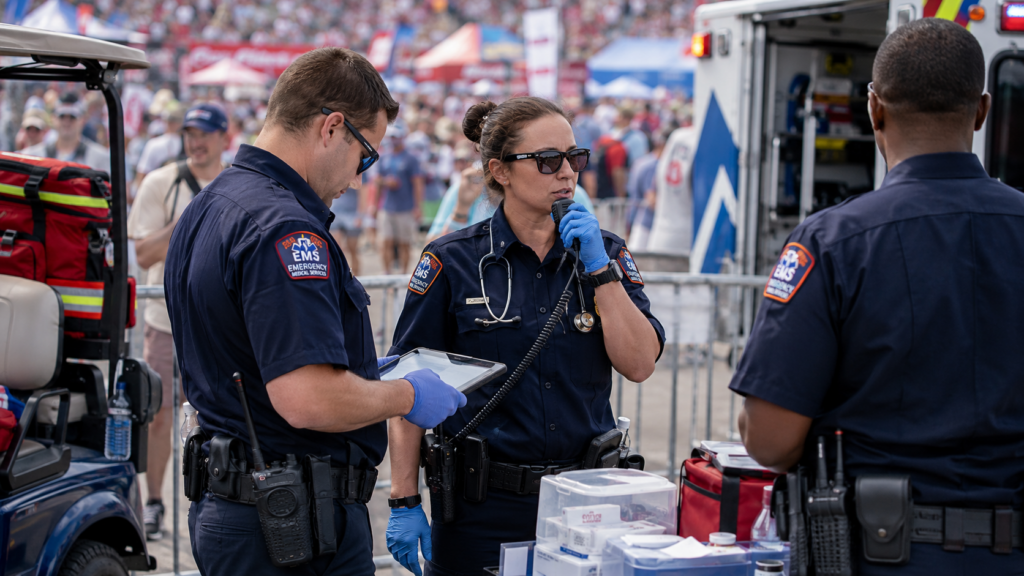
Large events do not just need security, parking, vendors, and a schedule.
They need medical readiness.
Concerts, festivals, school events, sporting events, trade shows, corporate gatherings, rodeos, marathons, and community events can all create medical demand. Most incidents may be minor, but the risk is never zero. Heat exhaustion, dehydration, falls, asthma attacks, cardiac symptoms, intoxication, crowd-related injuries, and transport needs can appear without warning. That is why EMS staffing for events should not be treated as an afterthought.
But there is another side to the problem: EMS providers cannot keep draining their permanent crews every time an event needs coverage.
If the same core team is pulled into event coverage again and again, the provider risks fatigue, scheduling pressure, overtime, morale problems, and weakened readiness for normal emergency response. The event may be covered, but the larger EMS operation becomes strained.
The better solution is planned, risk-based event EMS staffing.
StaffDash provides EMS staffing support for ambulance, medics, and event services, helping organizations have the right personnel in place when needed. StaffDash also lists EMS Staffing, MICU/ALS Ambulance Staffing, BLS Ambulance Staffing, Event Staffing, and On-Site Medics Staffing among its service areas.
Why Event EMS Coverage Needs Real Planning?
An event is not “safe” just because nothing happened last year.
That is weak planning.
Every event has its own risk profile. A seated indoor conference is not the same as a summer outdoor festival. A school sports event is not the same as a rodeo. A 300-person private gathering is not the same as a multi-day public event with alcohol, heat exposure, long walking distances, and limited access routes.
The CDC notes that emergency medical services are often involved in preparing for mass gatherings and are typically equipped to address acute medical conditions such as asthma, heat exhaustion, injuries, gastrointestinal illness, and myocardial infarction.
That matters because event medical planning is not only about putting an ambulance nearby. It is about matching the medical coverage plan to the environment, crowd, access points, transport routes, risk level, and local emergency response structure.
The Problem With Pulling From Core EMS Crews
Many EMS organizations try to cover events using the same permanent team already responsible for regular operations.
That may work once or twice. It does not scale well.
When permanent crews are repeatedly pulled into event coverage, the provider may face:
- Higher overtime
- Crew fatigue
- Schedule instability
- Reduced morale
- Coverage gaps elsewhere
- Harder vacation and leave planning
- Burnout risk
- More pressure on supervisors
- Less flexibility during emergency surges
The ugly truth is simple: if event coverage weakens normal emergency readiness, the staffing model is broken.
Event EMS support should strengthen service capacity, not cannibalize it.
Event Medical Staffing Should Be Based on Risk, Not Guesswork
The wrong question is, “How many medics do we usually send?”
The better question is, “What level of medical risk does this event create?”
Risk-based planning should consider:
- Expected attendance
- Event duration
- Indoor or outdoor setting
- Weather and heat exposure
- Alcohol availability
- Age range of attendees
- Physical activity level
- Crowd density
- Known medical history of participants, if applicable
- Distance from hospitals
- Ambulance access routes
- Potential transport volume
- Local EMS availability
- Whether BLS or ALS coverage is needed
The National Center for Biotechnology Information notes that mass gathering EMS planning should include medical preparation, coordination with event organizers and local government resources, transport options, documentation, and the role of medical direction.
That is the professional standard. Not “send whoever is free.”
BLS and ALS Coverage Should Not Be Treated the Same
Not every event requires the same level of care.
Basic Life Support and Advanced Life Support should be planned based on event risk, not assumptions. BLS event coverage may be appropriate for lower-acuity settings where basic assessment, first aid, monitoring, and transport support are the likely needs. ALS event coverage may be appropriate when the risk profile suggests a higher chance of advanced assessment, cardiac monitoring, medication administration, or higher-acuity intervention.
The mistake is assuming ALS should always be the default.
That is not smart planning. It can waste resources and create unnecessary staffing pressure.
BLS is not “less valuable.” It is the right level for the right situation when the clinical risk profile supports it.
StaffDash has specific service pages for MICU/ALS Ambulance Staffing and BLS Ambulance Staffing, which supports a more structured approach to matching coverage to operational need.
Event EMS Staffing Also Protects the Public System
Event planners often think only about the people inside the venue.
EMS leaders have to think bigger.
A major event can affect the wider emergency response system. If public EMS resources are pulled heavily into an event, the surrounding community may have less capacity available for normal 911 calls, hospital transfers, or urgent response needs.
The World Health Organization identifies mass gathering health planning as including risk assessment, surveillance and response, emergency planning, human resources, and transport procedures.
That is why event EMS staffing must be coordinated carefully. The goal is not only to protect event attendees. The goal is to protect attendees without compromising emergency readiness outside the event.
What EMS Providers Should Plan Before the Event
A strong EMS plan starts before the gates open.
EMS providers and event organizers should clarify:
- Who is responsible for medical direction?
- What level of staffing is required?
- Will coverage include EMTs, paramedics, nurses, or physicians?
- Will there be a fixed first-aid station?
- Will mobile medical teams be needed?
- Will an ambulance remain onsite?
- What happens if the onsite ambulance transports a patient?
- Is backup coverage available?
- How will incidents be documented?
- Where are the ambulance access points?
- How will EMS communicate with event security and organizers?
- What is the escalation plan for major incidents?
This is where many event plans fall apart. They have people present, but no clear system.
Staffing without coordination is just bodies in uniforms. Event EMS coverage needs roles, routes, communication, escalation, and documentation.
Why Supplemental EMS Staffing Makes Sense
Supplemental EMS staffing gives providers flexibility.
Instead of forcing the permanent team to absorb every event, EMS organizations can bring in qualified event medical personnel based on the event’s risk profile and schedule needs.
This helps providers:
- Cover more events
- Reduce overtime pressure
- Protect permanent crews
- Improve schedule reliability
- Support BLS and ALS planning
- Maintain normal EMS readiness
- Scale coverage for larger gatherings
- Respond to event demand without weakening the core operation
That is the strongest business case for event EMS staffing. It helps EMS providers say yes to more opportunities without quietly burning out the people who keep the service running.
How StaffDash Supports EMS Event Coverage?
StaffDash is positioned to support EMS providers, ambulance services, healthcare facilities, and event coverage needs through staffing solutions that include EMS staffing, medics, event services, BLS, ALS, and on-site medics.
For EMS leaders, the value is not only finding people. The value is building a staffing plan that supports the event without damaging the provider’s normal operations.
That may mean staffing for:
- Concerts
- Festivals
- School events
- Athletic events
- Corporate gatherings
- Community events
- Trade shows
- High-risk public events
- Private venue coverage
- Ambulance standby support
- BLS or ALS event coverage
The staffing model should match the event, not the other way around.
Final Thoughts
Event EMS staffing is not a box to check.
It is a risk management decision.
The wrong approach drains permanent crews, increases overtime, weakens morale, and may compromise normal emergency readiness. The right approach matches coverage to risk, separates event demand from core operations, and gives EMS providers a more scalable way to support public and private events.
For EMS providers, the goal is not just to cover the event.
The goal is to cover the event while keeping the rest of the operation strong.
If your EMS organization, ambulance service, venue, or event team needs support planning medical coverage, StaffDash can help evaluate staffing needs for EMS, BLS, ALS, ambulance, medics, and event medical support.
EMS staffing for events helps EMS providers, ambulance services, venues, and event organizers plan medical coverage without draining permanent emergency response crews. A strong event EMS staffing plan should consider attendance, event risk, duration, weather, alcohol use, venue layout, ambulance access, BLS or ALS needs, transport procedures, documentation, and coordination with medical direction and local emergency resources.
Frequently Asked Questions
What is EMS staffing for events?
EMS staffing for events means assigning qualified EMTs, paramedics, ambulance personnel, Non-EMT drivers (if applicable in your state), medics, or medical teams to support planned events such as concerts, festivals, sporting events, corporate gatherings, school events, and public gatherings.
Why do events need EMS staffing?
Events need EMS staffing because medical issues can happen without warning. Common event-related medical needs may include injuries, heat illness, dehydration, asthma symptoms, intoxication-related concerns, cardiac symptoms, and transport needs.
Should every event have ALS coverage?
No. ALS should not be treated as the automatic default. The right level of coverage depends on event risk, patient acuity expectations, local protocols, medical direction, and transport planning. Some events may be appropriate for BLS coverage, while higher-risk events may require ALS support.
How does event EMS staffing protect permanent crews?
Supplemental event EMS staffing reduces the need to repeatedly pull core crews into event coverage. This can help lower overtime, reduce fatigue, protect morale, and maintain normal emergency response readiness.
Does StaffDash provide EMS and event staffing?
Yes. StaffDash provides EMS staffing services, including staffing support for ambulance, medics, and event services. StaffDash also offers related services such as BLS Ambulance Staffing, Non-EMT Transport Staffing, MICU/ALS Ambulance Staffing, Event Staffing, and On-Site Medics Staffing.