
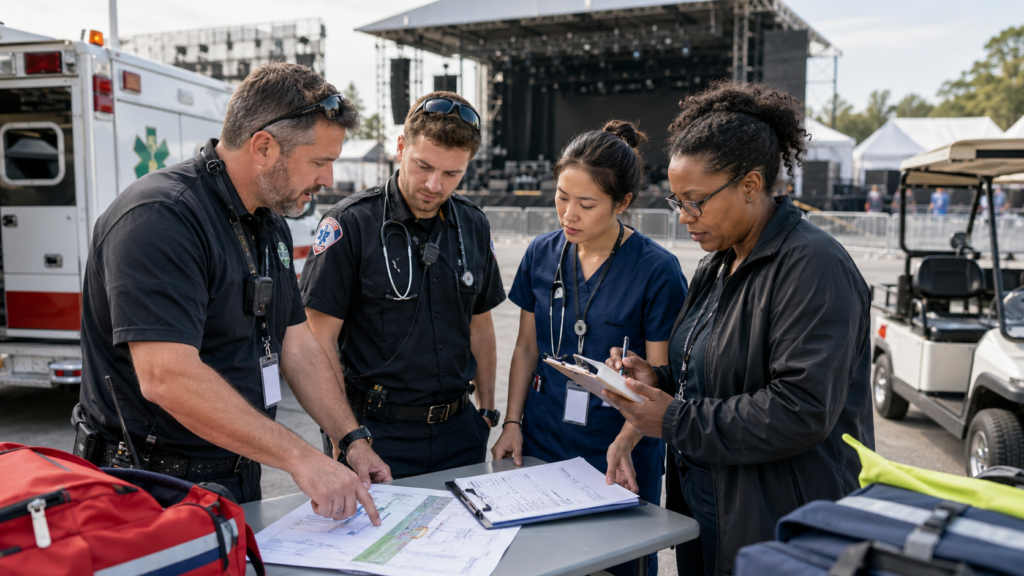
Medical coverage should be part of event planning long before attendees arrive. Crowd size, venue access, weather, event activity, alcohol service, transport routes, and the availability of local emergency services can all affect the level of support an event may require. A plan that works for a small indoor conference may be completely inadequate for a road race, music festival, school tournament, or remote outdoor gathering.
The goal is not to place the highest level of medical resource at every event. It is to understand the risk, choose an appropriate mix of personnel and equipment, define how incidents will be escalated, and make sure everyone knows how to activate the medical response before the crowd arrives.
Organizations that need help building or supplementing this plan can use event staffing support to align event personnel with the operational demands of the venue and program.
Quick Answer: What Should an Event Medical Staffing Plan Include?
A practical event medical staffing plan should define the event risk profile, the qualifications and number of on-site responders, first aid locations, mobile response routes, communication channels, equipment, documentation procedures, escalation thresholds, ambulance access, transport contingencies, and coordination with venue leadership and local public-safety resources. There is no universal staffing formula that fits every event.
What Is Event Medical Staffing?
Event medical staffing is the planned use of qualified medical personnel and supporting resources to respond to illness or injury during a scheduled gathering. Depending on the event and local requirements, that may include trained first aid personnel, EMTs, paramedics, nurses, mobile response teams, treatment areas, or ambulance standby.
Medical staffing is different from general event operations. Security, ushers, registration staff, and venue teams may help identify incidents and direct responders, but they do not replace qualified clinical or EMS personnel. A complete plan connects these teams so that the right person is notified quickly when an incident occurs.
For events that require EMT or paramedic coverage, a structured EMS staffing plan can help organizers build capacity around the expected risk without unnecessarily pulling resources from unrelated operations.
Why Medical Coverage Should Be Planned Before the Event
At a crowded venue, the first challenge is often not treatment. It is finding the patient, reaching them quickly, moving through the crowd, communicating with security, and deciding whether the person can be managed on site or needs additional emergency care. Those decisions become harder when response routes, treatment locations, and communication channels have not been established in advance.
The NCBI Bookshelf overview of EMS at mass gatherings describes mass-gathering medical planning as a collaborative process involving event organizers, EMS leaders, medical direction, public health, security, and surrounding healthcare resources. The practical lesson is straightforward: medical response works better when it is integrated into the event plan rather than added at the last minute.
The federal EMS.gov preparedness resources also point planners toward mass-gathering and special-event tools, case studies, and templates designed to support robust pre-incident planning.
For basic readiness, the American Red Cross first aid resources reinforce the value of having people who are prepared to recognize and respond to emergencies while professional help is being activated.
The Event Medical Staffing Risk Filter
Before deciding how many people to schedule, review the event itself. A staffing plan should be based on the actual risk profile, not a generic attendee count or a one-size-fits-all ratio.
- Crowd size and density: Larger or tightly packed crowds can increase incident frequency and make access more difficult.
- Audience profile: Children, older adults, athletes, or people with known accessibility or medical needs may change the response plan.
- Event activity: Endurance sports, contact sports, concerts, festivals, motorsports, and trade shows create different medical and operational risks.
- Environment: Heat, cold, rain, altitude, poor ventilation, uneven terrain, and long walking distances can increase risk and slow response.
- Alcohol or substance exposure: Events with alcohol service or a higher likelihood of substance use may require stronger escalation and transport planning.
- Venue access: Narrow corridors, blocked loading areas, multiple floors, controlled entrances, and long distances from vehicle access can affect response time.
- Distance to emergency care: Events far from receiving facilities or public EMS resources may need more on-site capability and a stronger transport contingency.
- Event duration and timing: Multi-day, overnight, or extended events can create fatigue, hydration, staffing-rotation, and supply requirements.
- Local requirements: Permits, venue rules, state or local EMS requirements, medical direction, and public-safety expectations can all influence the final plan.
EMT, Paramedic, Nurse, First Aid, or Ambulance Standby: What May Be Appropriate?
The table below is a planning guide, not a universal staffing standard. Final decisions should follow applicable state and local requirements, venue rules, permit conditions, local EMS protocols, medical direction, and the event-specific risk assessment.
| Coverage Option | May Be Appropriate When | Planning Considerations |
|---|---|---|
| First aid station | The event has a lower-risk profile and the plan calls for a visible location for basic assessment and first aid. | The station should be easy to find, appropriately staffed and supplied, and connected to a clear escalation process. |
| EMTs | The event may require trained emergency assessment, basic life support readiness, and rapid identification of cases that need escalation. | Confirm scope, equipment, communications, mobility, documentation, and access to additional EMS resources. |
| Paramedics | The risk assessment indicates a greater likelihood of higher-acuity emergencies or delayed access to additional advanced care. | Advanced capabilities should be integrated with medical direction, protocols, transport planning, and local EMS coordination. |
| Nurses | The event includes ongoing care, observation, wellness, screening, medication-related, or documentation needs that fit an appropriate nursing role. | Define scope, supervision, licensure requirements, referral pathways, and when EMS activation is required. |
| Ambulance standby | Delayed transport could materially affect emergency response, or standby is required by the event plan, venue, permit, authority, or medical risk profile. | Confirm whether the unit is dedicated, the expected service level, access routes, receiving facilities, and what happens if the ambulance transports a patient. |
The 11-Point Event Medical Staffing Checklist
1. Define the event risk level
Document attendance, venue type, activity, duration, environment, alcohol service, audience profile, and expected medical risk.
2. Confirm local requirements and medical authority
Verify permit conditions, venue requirements, applicable EMS rules, medical direction, and coordination expectations before finalizing coverage.
3. Map medical response zones
Identify first aid locations, mobile response routes, ambulance access points, staff-only corridors, evacuation routes, and known bottlenecks.
4. Match personnel to the risk profile
Select first aid staff, EMTs, paramedics, nurses, or ambulance support based on the event plan rather than hiring blindly.
5. Set escalation thresholds
Define what can be handled on site, when local EMS or 911 should be activated, who can request transport, and who has final operational authority.
6. Build a communication chain
Give medical staff, security, event leaders, dispatch, venue management, and other key teams a simple communication process before doors open.
7. Prepare supplies and equipment
Confirm what equipment is needed, where it will be stored, who inspects it, and how depleted supplies will be replaced during the event.
8. Plan documentation and privacy
Define how incidents will be documented, who maintains records, and how patient information will be handled according to applicable policies and requirements.
9. Coordinate ambulance and transport access
Keep transport routes clear, identify receiving-facility options, and plan for the possibility that a dedicated ambulance may leave the venue with a patient.
10. Brief non-medical event staff
Security, ushers, registration teams, volunteers, and event coordinators should know where medical help is located and how to activate it.
11. Debrief after the event
Review incidents, response times, documentation, equipment use, communication failures, and recommended changes before the next event.
When Ambulance Support Becomes Part of the Plan?
Some events need more than on-site assessment. An organizer should consider transport readiness when the venue is remote, the event has a higher-acuity risk profile, public EMS response may be delayed, or local requirements call for dedicated standby. The plan should also address what happens if the assigned ambulance transports a patient and is no longer available on site.
For organizers that need to supplement transport readiness, ambulance staffing support can be considered as part of the broader event medical plan. The specific level of ambulance coverage should be based on the event risk assessment and applicable requirements rather than treated as an automatic default.
Common Event Medical Planning Mistakes
- Using crowd size as the only staffing factor.
- Assuming one medic can cover a large or complex venue without considering travel time and simultaneous incidents.
- Creating a first aid station without a clear escalation or transport pathway.
- Failing to coordinate medical responders with security and venue operations.
- Blocking ambulance access with vendors, barricades, rideshare zones, or production vehicles.
- Ignoring what happens when the only ambulance leaves with a patient.
- Treating documentation, post-event review, and equipment replenishment as optional.
How StaffDash Fits Into Event Medical Planning?
Event medical coverage should be matched to the actual risks and operating conditions of the event. StaffDash can support organizations that need qualified EMS, medical, or ambulance personnel to supplement an existing plan, fill coverage gaps, or scale staffing for a specific event.
The strongest approach starts with the event plan first: identify the work, the risk, the required qualifications, the supervision model, and the escalation pathway. Staffing can then be matched to those needs instead of forcing the event into a predetermined staffing package.
Bottom Line
Event medical staffing is a planning function, not a last-minute add-on. Organizers should define the risk profile, confirm local requirements, map response and transport routes, choose appropriately qualified personnel, establish communication and escalation rules, and review the plan with the relevant operational and medical stakeholders before the event begins.
There is no universal staff-to-attendee ratio that works for every gathering. A safer plan is one that reflects the specific crowd, venue, activities, environment, local EMS system, and response resources available on the day.
Planning an event that needs medical coverage? Talk with StaffDash about event medical staffing, EMS personnel, and ambulance support based on your venue, crowd profile, and coverage requirements. Contact StaffDash
Frequently Asked Questions
What is event medical staffing?
Event medical staffing is the planned use of qualified medical personnel and supporting resources to respond to illness or injury during a scheduled gathering. Depending on the event, this may include first aid staff, EMTs, paramedics, nurses, treatment areas, mobile teams, or ambulance standby.
How do I know whether my event needs EMTs or paramedics?
Start with the event risk assessment. Crowd density, physical activity, environment, alcohol service, venue access, transport time, and local requirements can all affect the level of medical coverage that may be appropriate. The final plan should follow applicable rules, protocols, medical direction, and venue requirements.
How many medical staff does an event need?
There is no universal staff-to-attendee ratio that applies to every event. Coverage should be based on the event risk profile, expected attendance, venue layout, activities, operating hours, transport access, local requirements, and the availability of nearby emergency resources.
Is a first aid station enough for an event?
It may be sufficient for some lower-risk events, but a first aid station is only one part of the response plan. Higher-risk or more complex gatherings may need mobile responders, EMTs, paramedics, nurses, ambulance standby, or stronger escalation arrangements.
Should event medical staff coordinate with security?
Yes. Security or venue staff may identify incidents first, while medical teams assess and manage the patient. Communication channels, access routes, and activation procedures should be agreed before the event begins.
When should an event consider ambulance standby?
Ambulance standby may be appropriate when delayed transport would create significant risk, the venue is remote, the event profile is higher acuity, public EMS access may be limited, or standby is required by the event plan, permit, venue, authority, or applicable local requirements.
How can StaffDash help with event medical staffing?
StaffDash can help organizations supplement event medical coverage with qualified personnel based on the roles, credentials, schedule, and operational needs identified in the event plan.