
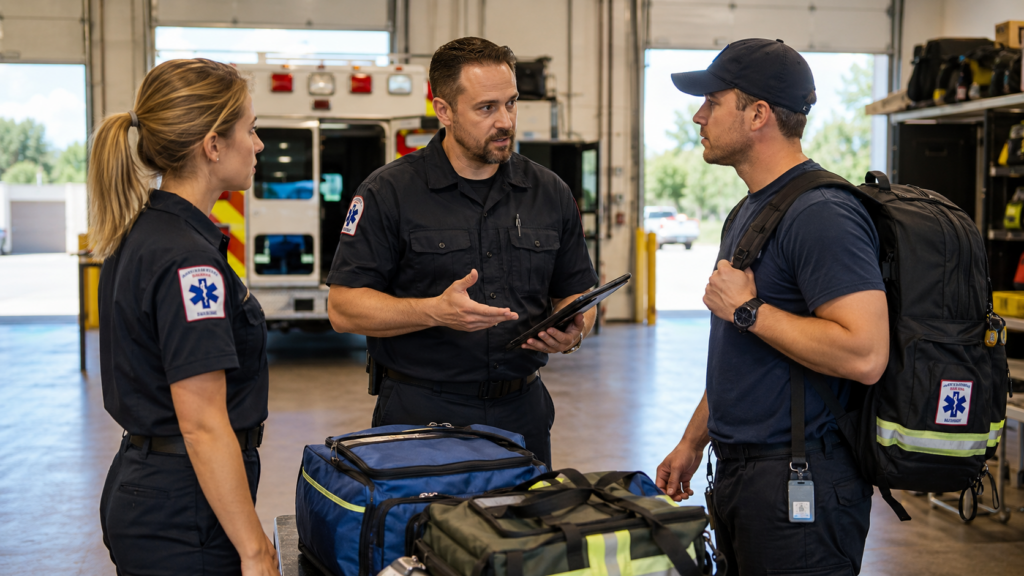
Travel paramedic jobs are often treated as a quick fix for EMS staffing gaps. That’s the wrong way to think about them.
A travel paramedic can help an EMS agency, ambulance service, hospital transport program, event medical team, or rural coverage area fill a time sensitive operational need. But the assignment only works when the receiving organization has planned for credentialing, onboarding, scope alignment, housing or travel logistics, scheduling, supervision, and communication before the medic arrives.
StaffDash provides healthcare staffing services across EMS, ambulance, medical, clinician, non clinician, event, remote RN, and onsite workforce needs. For EMS leaders, travel paramedics should be viewed as part of a staffing plan, not a substitute for planning.
Direct Answer
Travel paramedic jobs help EMS agencies and healthcare organizations fill temporary, contract, or surge coverage needs. The strongest assignments are planned around credentialing, state licensure, scope of practice, shift structure, onboarding, housing logistics, supervision, and agency-specific protocols before the paramedic starts work.
What Is a Travel Paramedic?
A travel paramedic is a licensed paramedic who accepts short term, contract, temporary, or location based assignments outside their usual work setting. These assignments may support 911 EMS systems, interfacility transport, hospital based transport teams, event medical operations, disaster response, rural coverage, or temporary staffing gaps.
This is different from casually picking up a shift in a nearby city. Travel paramedic assignments often involve a defined contract period, credential verification, assignment specific onboarding, travel coordination, and a clear understanding of where the paramedic can practice and under whose medical direction.
The BLS EMT and paramedic outlook describes EMTs and paramedics as professionals who assess injuries and illnesses, provide emergency medical care, and may transport patients to medical facilities. The outlook also projects a 5% employment growth for EMTs and paramedics from 2024 to 2034, with about 19,000 openings per year on average.
Why Do EMS Agencies Use Travel Paramedics?
EMS agencies usually consider travel paramedics when normal recruiting, overtime, mutual aid, or per diem coverage is no longer enough. The pressure may be temporary, seasonal, geographic, or tied to a specific contract requirement.
- Seasonal patient volume increases
- Rural or remote coverage needs
- Long term vacancies
- Expanded transport contracts
- Event or special operations coverage
- Short term leave coverage
- Disaster response or public-health surge support
- Hard to fill ALS coverage needs
StaffDash’s EMS staffing support is relevant here because travel paramedic coverage often sits inside a larger EMS staffing conversation. Agencies aren’t only looking for a person, they’re looking for coverage that fits the assignment, the system, and the risk profile.
The Biggest Mistake: Treating Travel Paramedics Like Plug and Play Labor
A travel paramedic may arrive with strong clinical experience, but that doesn’t mean the assignment is automatically operationally ready.
Every EMS system has its own protocols, documentation workflow, radio procedures, dispatch environment, geography, equipment layout, hospital relationships, station culture, medical-direction structure, and quality review process. If the agency does not prepare for those differences, the travel paramedic can spend too much time figuring out the system instead of fitting into it.
That doesn’t mean travel paramedics are risky. It just means rushed onboarding is risky. The staffing plan needs to account for the realities of field operations.
Credentialing, Licensure, and Scope Must Be Reviewed First
This is where healthcare and EMS leaders need to be disciplined.
A paramedic’s credentials, certifications, licensure, medical direction, and permitted scope of practice must match the assignment. A travel paramedic who is properly qualified in one state or setting may still need additional verification before working in another jurisdiction or agency.
The National EMS Scope of Practice Model provides national descriptions for EMS clinician levels, including emergency medical responder, EMT, advanced EMT, and paramedic. However, EMS.gov also makes clear that scope of practice is established by individual states and territories.
For technical reference, the NHTSA scope model report is the underlying federal resource for the 2019 National EMS Scope of Practice Model and subsequent change notices. Facilities should still confirm current state rules, agency policy, medical director requirements, and assignment-specific privileges before work begins.
What Travel Paramedic Assignments Should Clarify Before Day One?
A good travel paramedic assignment should not start with vague expectations. Before day one, the agency should define the operational basics.
- Assignment length and renewal expectations
- Shift schedule, rest expectations, and overtime rules
- Station location and deployment model
- Vehicle type, equipment setup, and communication process
- State licensure and credential verification requirements
- Local protocols and medical direction
- Documentation and electronic patient care reporting workflow
- Housing, transportation, and travel logistics, if applicable
- Chain of command and escalation process
- Quality assurance and incident reporting expectations
If those details are not settled upfront, the assignment can become messy. The goal is not to overcomplicate the process. The goal is to remove preventable friction.
Travel Paramedics and Ambulance Coverage Planning
Travel paramedics often become most valuable when an ambulance service needs short-term ALS capacity, temporary schedule stabilization, or added support for a contract period. But leaders shouldn’t automatically assume that adding paramedics is the only solution.
The better question is: what type of coverage does the system actually need?
- Does the agency need ALS support, BLS support, or a mixed staffing model?
- Is the gap caused by call volume, vacancies, leave coverage, turnover, or contract growth?
- Will travel paramedics be used in 911 response, interfacility transport, standby coverage, or special operations?
- Does the system have enough supervisors, field training support, and dispatch clarity to integrate temporary staff?
StaffDash’s page on ambulance staffing needs is the natural next step for EMS operators reviewing how short-term or contract coverage should fit into their service model.
Travel Paramedics Are Not Only for 911 EMS
Some organizations make another mistake: they assume travel paramedics are only relevant for 911 response. In reality, paramedic travel contracts may also support hospital transport teams, interfacility transfer programs, event medical coverage, remote facilities, and temporary healthcare operations.
For example, a hospital system may need paramedic-level support for transport coverage during a staffing shortage. An event organizer may need experienced medics for a high-risk venue or multi-day operation. A rural facility may need temporary EMS support while recruiting permanent staff.
StaffDash’s medics staffing support can assist in this broader conversation because the need may extend beyond one ambulance unit or one shift.
How Workforce Pressure Makes Travel Paramedic Planning More Important?
Travel paramedic jobs exist because EMS workforce pressure is real. Agencies are dealing with call-volume demands, retention issues, overtime pressure, hard-to-fill shifts, and the operational difficulty of keeping units staffed while protecting coverage reliability.
The EMS.gov workforce guidance states that effective EMS systems depend on a stable, supported, and well trained workforce. It also notes that NHTSA’s Office of EMS supports workforce research and resources for EMS clinicians.
That point matters. Travel paramedics should not be used as a sign that an agency has given up on permanent hiring. They should be used as one tool inside a broader workforce plan that may include permanent recruiting, per diem support, contract staffing, retention work, field leadership support, and better scheduling visibility.
How to Avoid Overbuilding the Travel Paramedic Plan?
Overbuilding the plan is another common problem. Some agencies assume more paramedic-level coverage is always better. That is not necessarily true.
Travel paramedic staffing should be matched to the actual assignment. A rural ALS shortage, a high-acuity transport contract, a standby event, and a hospital transfer program may all require different coverage models. The staffing plan should account for call type, state requirements, medical direction, scope, supervision, workload, and the level of care required.
When ALS coverage is part of the question, StaffDash’s ALS ambulance staffing support can help frame the conversation around the right level of coverage rather than defaulting to the most expensive or most aggressive option.
When Onsite Coordination Becomes Necessary?
For a small temporary assignment, a simple staffing arrangement may be enough. For a larger operation, onsite coordination may be the difference between a clean deployment and daily confusion.
This is especially true when multiple travel clinicians, overlapping schedules, compliance documents, assignment renewals, onboarding steps, and supervisor communication are involved.
StaffDash’s onsite staffing management is relevant for organizations that need more than individual placements. Larger programs may need workforce tracking, onboarding coordination, scheduling support, compliance visibility, and a clearer communication structure.
What EMS Leaders Should Ask Before Hiring Travel Paramedics?
Before opening travel paramedic jobs or travel paramedic contract jobs, EMS leaders should ask practical questions:
- What exact coverage gap are we solving?
- Is this a short term surge, long term vacancy, event need, transport need, or emergency backfill?
- Does the role require ALS, critical care, event medical, interfacility, or 911 experience?
- What credentials, state licensure, and medical-direction approvals are required?
- Who owns onboarding, scheduling, and quality review?
- How will the travel paramedic learn local geography, hospitals, dispatch process, and equipment?
- What housing, transportation, travel reimbursement, or shift rotation details must be clarified?
- What is the plan if the assignment needs to extend?
Those questions are not administrative clutter. They protect the assignment from being thrown together at the last minute.
Key Takeaway
Travel paramedic jobs can help EMS agencies and healthcare organizations address temporary, contract, seasonal, rural, or surge staffing needs. But travel paramedics should not be treated as plug and play labor.
The strongest staffing plans define the assignment, verify credentialing and licensure, align scope of practice, clarify onboarding, confirm logistics, and connect the travel paramedic to the agency’s operational workflow before the first shift.
The decision is not simply whether to hire a travel paramedic. The real decision is whether the organization is prepared to use that paramedic correctly
When to Contact StaffDash?
Contact StaffDash when your EMS agency, ambulance service, healthcare facility, event operation, or transport program needs travel paramedic coverage, EMS staffing support, medics staffing, ambulance staffing, ALS support, or onsite workforce coordination.
StaffDash can help evaluate staffing needs and support short-term, long-term, per diem, contract, and workforce management conversations. No staffing partner can promise perfect coverage or guaranteed operational outcomes, but the right planning process can reduce avoidable confusion before coverage gaps become harder to manage.
Frequently Asked Questions
1. What is a travel paramedic?
A travel paramedic is a licensed paramedic who accepts temporary, contract, or location-based assignments outside their usual work setting. These assignments may support EMS agencies, ambulance services, hospital transport programs, event medical teams, rural coverage areas, or temporary staffing gaps.
2. Are travel paramedic jobs different from regular paramedic jobs?
Yes. Regular paramedic jobs are usually tied to one employer or service area. Travel paramedic jobs often involve short term assignments, contract periods, relocation or travel logistics, assignment specific onboarding, and additional credentialing or licensure review.
3. Why do EMS agencies hire travel paramedics?
EMS agencies may hire travel paramedics to cover vacancies, seasonal surges, rural staffing gaps, event coverage, disaster response, expanded transport contracts, or short term leave coverage. The exact reason should be defined before the assignment begins.
4. What should agencies verify before using travel paramedics?
Agencies should verify licensure, certifications, scope of practice, medical direction, background requirements, assignment duties, schedule expectations, documentation workflow, vehicle/equipment familiarity, local protocols, and onboarding responsibilities.
5. Do travel paramedics need state licensure?
In most cases, the paramedic must be authorized to practice in the state or jurisdiction where the assignment takes place. Requirements vary by state, territory, agency, and medical director, so leaders should verify current rules before scheduling the paramedic.
6. Can travel paramedics support ambulance staffing?
Yes. Travel paramedics may support ambulance staffing, especially for ALS coverage, interfacility transport, temporary vacancies, rural assignments, or surge needs. The assignment should match the agency’s clinical, operational, and regulatory requirements.
7. When should an EMS agency contact StaffDash about travel paramedics?
An EMS agency should contact StaffDash when it needs temporary or contract paramedic coverage, hard to fill shifts, ALS support, rural staffing support, event medical coverage, or workforce planning help before staffing gaps disrupt operations.