
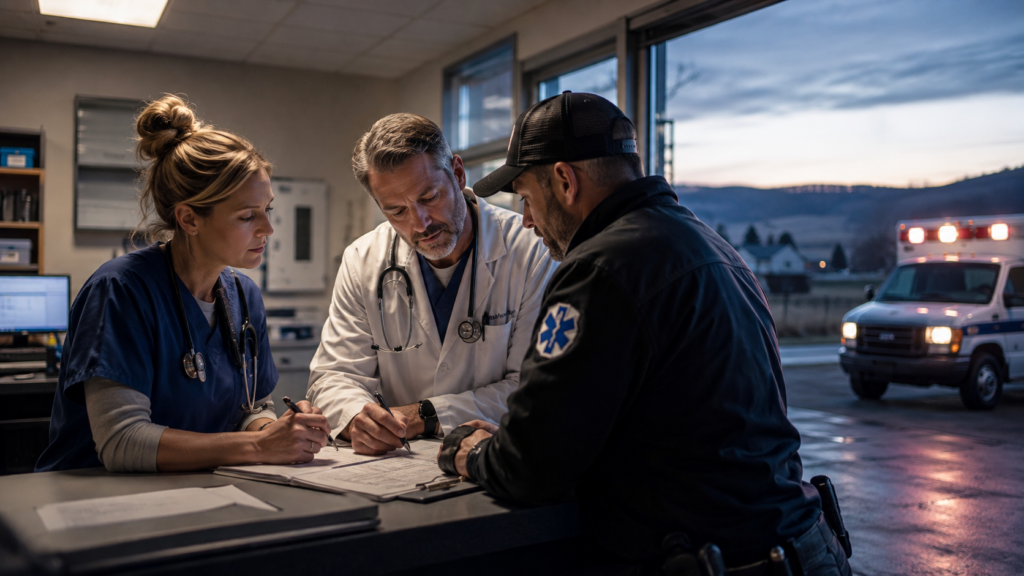
At 5:40 a.m., a department leader learns that the only employee qualified for a critical function will be unavailable for the next seven days. The schedule still shows names. The facility still has policies. Yet nobody can immediately answer three basic questions: Who is truly available, who is fully ready to work, and who has the authority to change operations if coverage cannot be restored?
That is the failure a staffing contingency drill is designed to expose before it happens in real life.
| Practical answerA rural healthcare staffing contingency drill is a structured, low-risk exercise that tests whether a small hospital, clinic, or EMS system can maintain an essential service after a critical absence. It does not replace recruitment or a written staffing plan. It verifies whether the plan works under time pressure—when availability, credentials, facility access, travel, housing, scheduling, and escalation all have to work together. |
Why Is a Written Staffing Plan Not Enough?
Most organizations already have some version of a backup plan. It may be a call list, an agency agreement, a mutual-aid contact, a float roster, or a manager who “knows who to call.” The problem is that these resources are often treated as available without being tested.
A name on a spreadsheet is not coverage. A clinician may have changed availability. A license may be active while a required competency, facility privilege, health document, badge, or EHR access is incomplete. A staffing partner may be under contract but still need a realistic lead time. A neighboring EMS agency may be willing to assist but unable to release a crew during the same high-demand period.
The drill forces the organization to replace assumptions with evidence.
FEMA’s exercise guidance is designed for broader emergency preparedness, but its basic discipline applies here: define objectives, run a controlled scenario, evaluate performance, document weaknesses, and assign corrective actions. The value is not the meeting itself. The value is the improvement work that follows.FEMA exercise and evaluation guidance
What Should the Drill Prove?
A useful drill should answer one operational question:
| Test objectiveCan this organization keep a defined service available when a specific person, crew, credential, or support function disappears from the schedule? |
Do not begin with a vague scenario such as “we have a staffing shortage.” That produces vague discussion. Choose one failure that could realistically interrupt care.
- The only CT technologist available for weekend coverage is absent for seven days.
- A rural clinic loses its only nurse practitioner during a high-demand week.
- One paramedic vacancy prevents an ambulance from meeting the required crew configuration.
- A laboratory employee with a required bench competency becomes unavailable.
- A registration or eligibility specialist is absent and the clinic’s front-end workflow begins to fail.
- A credentialing coordinator leaves while several external workers are scheduled to start.
- Severe weather blocks the normal travel route for an incoming temporary professional.
The scenario should be difficult enough to reveal weaknesses but narrow enough to test in 60 to 90 minutes.
Set the Rules Before the Exercise Starts
A contingency drill fails when participants solve the scenario by inventing resources that do not exist. Set clear rules before the clock starts.
- Freeze the current staffing roster. Participants may use only people who are genuinely employed, contracted, or available through a documented regional or external relationship.
- Use current records. Check real credential files, access status, orientation completion, travel expectations, and contact information. Do not assume “HR probably has it.”
- Assign decision authority. Identify who may approve overtime, activate external staffing, change a clinic schedule, reduce nonessential activity, request mutual aid, arrange transfers, or communicate a service limitation.
- Separate clinical approval from administrative action. A staffing coordinator may source coverage, but clinical leadership must determine whether the professional is appropriate for the assignment and whether the service can safely operate.
- Appoint one evaluator. This person records timing, missed steps, unclear ownership, and every moment when the team relies on an unsupported assumption.
A 90-Minute Rural Staffing Contingency Drill
The following format can be adapted to a small hospital, rural clinic, or EMS system.
Minute 0: Announce the Absence
Provide a short scenario card. State the role, duration of absence, affected shifts, service consequence, and any known constraints. Avoid adding unnecessary drama. The objective is to test the staffing system, not surprise participants with unrelated emergencies.
Minute 10: Define the Operational Consequence
The team must state what fails if the role remains uncovered. Will an ambulance be placed out of service? Will imaging hours be reduced? Will clinic appointments be cancelled? Will patients require transfer? Will another employee be pushed into unsafe or unsustainable overtime? Urgency should be based on service impact, not job title alone.
Minute 20: Activate the First Backup
Use the organization’s normal internal or regional pathway. Call or simulate contact with the people listed as backup. Confirm actual availability, required competency, schedule compatibility, and whether accepting the assignment creates a new gap elsewhere. A backup who creates another critical vacancy is not a solution.
Minute 35: Verify Readiness
For every potential replacement, verify active license or certification where applicable, required competency, facility credentialing or privileges, screening and health requirements, orientation, system access, supervisor contacts, and shift expectations. Do not award a pass because the person is qualified in general. The question is whether the person is ready for this specific assignment.
Minute 50: Test External Activation
If internal coverage is insufficient, activate the external pathway. The facility should be able to provide a complete role brief without rebuilding it from scratch: role, schedule, location, competencies, start date, assignment length, reporting line, onboarding, travel, housing, call expectations, and known risks.
Minute 65: Test Travel and Housing
Confirm who arranges travel, whether weather or distance affects arrival, what lodging is available, how late arrivals are handled, and whether local transportation is required. A candidate who accepts but cannot reach the site before the first shift is not coverage.
Minute 75: Trigger the Escalation Decision
Assume the gap remains partly unresolved. Leadership must decide whether to prioritize essential services, reschedule lower-risk work, use clinically appropriate remote support for eligible functions, request mutual aid, arrange transfers, or activate an approved service-reduction plan.
Minute 85: Communicate the Decision
Identify who must be informed, what they need to know, and when. Depending on the scenario, that may include staff, medical leadership, dispatch, partner facilities, patients, transport partners, executives, compliance, credentialing, or the staffing partner.
Minute 90: Stop and Record the Result
End on time. Record uncovered hours, unresolved decisions, missing documents, inaccurate contacts, and actions that depended on one person’s memory. Capture the failures before trying to repair the entire system.
How the Drill Changes by Facility Type?
Small Rural Hospital
A small hospital should test a role that can remove a service or trigger transfers. Imaging, laboratory, respiratory therapy, emergency coverage, pharmacy support, and specialty call are common examples. The drill should examine whether the hospital can preserve required services, whether another department or regional partner can provide qualified support, and how transfer decisions are made when local capability is limited.
CMS treats Critical Access Hospitals and Rural Emergency Hospitals as different provider types. A staffing exercise must therefore start with the facility’s actual operating requirements rather than a generic “rural hospital” template.CMS Critical Access Hospitals
Rural Clinic
A rural clinic may have predictable hours but little redundancy. One clinician absence can remove a full day of appointments. One medical assistant gap can reduce rooming capacity. One registration failure can push administrative work onto clinical staff.
The drill should test appointment prioritization, patient communication, cross-site support, eligible remote workflows, front-desk continuity, prescription and message routing, and the point at which the clinic reduces or reschedules services. The objective is not to keep every appointment at any cost. It is to protect continuity, safety, and clear communication without overloading the remaining team.
Rural EMS System
EMS coverage must be tested by hour, certification level, crew configuration, response zone, and backup obligation, not by total roster size.
A system may have enough people on paper but still lack a qualified paramedic for a specific period. Mutual aid may exist but involve longer response times or competing obligations. A manager may be licensed but unable to cover routinely without abandoning command responsibilities.
The drill should test crew availability, medical direction, dispatch notification, unit status, mutual-aid activation, vehicle readiness, fatigue exposure, and the time needed to bring in external EMS personnel.
Eight Measures That Reveal Whether the Plan Works
| Measure | What it reveals |
|---|---|
| Time to identify service consequence | How long did it take to determine what would close, slow down, or become unsafe? |
| Time to reach a real backup | How quickly did the team contact someone who was actually available? |
| Readiness pass rate | How many potential backups had current credentials, competency evidence, orientation, and access? |
| External activation lead time | How long did it take to send a complete and usable staffing request? |
| Travel and housing confirmation | Could the organization verify how an external worker would reach and stay near the site? |
| Unresolved coverage hours | After all normal pathways were tested, how many hours remained uncovered? |
| Decision latency | How long did leadership take to approve the next operational action? |
| Corrective-action closure | Were weaknesses assigned to an owner and fixed by the agreed deadline? |
Common False Passes
“We have someone on the list.”
A list proves that a name was recorded. It does not prove availability, readiness, or willingness to accept the schedule.
“The license is active.”
Active licensure is only one control. The assignment may also require competency validation, privileges, screening, orientation, access, and role-specific approval.
“We have a staffing agency contract.”
A contract is not a deployed worker. The facility still needs an accurate role brief, realistic lead time, clear onboarding requirements, and prompt decisions.
“Mutual aid will cover it.”
The agreement should be tested against distance, concurrent demand, crew availability, communication, and activation authority.
“The manager can cover.”
A manager may be qualified and still be the wrong routine backup. Pulling leaders into operations can create a second failure in supervision and coordination.
“We can use overtime.”
Overtime may bridge a short gap. It should not be the only answer when the same employees already carry nights, weekends, calls, or extended shifts.
Turn the Drill Into a 30-Day Improvement Plan
The exercise is wasted if the findings remain in meeting notes.
Within 48 hours, document each weakness, the operational risk, the corrective action, the owner, and the due date. Separate quick repairs from structural work.
Quick repairs may include updating phone numbers, removing expired names, completing access requests, clarifying activation authority, confirming lodging, or finishing a role brief.
Structural work may include cross-training qualified staff, renegotiating a regional agreement, changing call distribution, building a second credentialing owner, adjusting the staffing budget, or establishing earlier activation thresholds for external coverage.
Within 30 days, rerun the failed part of the exercise. Do not wait a year to learn whether the correction worked.
Where StaffDash Fits?
StaffDash can support the external staffing portion of a rural contingency plan by helping facilities define role requirements and source qualified medical, clinical, EMS, or other healthcare personnel aligned with the assignment.
The strongest use of a staffing partner happens before the schedule breaks. A facility can share recurring exposure, hard-to-cover shifts, credential requirements, travel constraints, and likely activation triggers in advance. That preparation does not guarantee immediate coverage, but it removes avoidable delays when the need becomes real. Review StaffDash medical staffing services and EMS staffing support for relevant coverage options.StaffDash medical staffing services
StaffDash EMS staffing support
StaffDash can also participate in a facility’s tabletop exercise by reviewing whether the external role brief is complete and whether the proposed lead time is realistic. The facility remains responsible for local credentialing, privileges, scope, supervision, access, policy, and operational decisions.
The Bottom Line
A rural staffing plan is only as strong as its first real test.
Small hospitals, clinics, and EMS systems do not need a complicated simulation to find dangerous assumptions. They need one realistic absence, one clock, current records, decision makers in the room, and the discipline to document what fails.
The goal is not to prove that the organization can solve every vacancy. The goal is to know, before patient access is affected, where coverage will break, how quickly the next response can be activated, and who has authority to protect essential services.
| Is your backup plan based on verified readiness or an old contact list? Contact StaffDash to discuss external staffing preparation for a rural hospital, clinic, or EMS system before the next critical absence tests the plan for you. |
Frequently Asked Questions
What is a rural healthcare staffing contingency drill?
It is a controlled exercise that tests whether a rural hospital, clinic, or EMS system can maintain a defined service after a critical employee, crew, credential, or support function becomes unavailable.
How is a staffing drill different from a staffing plan?
A plan describes what should happen. A drill tests whether contacts, credentials, access, travel, housing, decision authority, and escalation steps work under a realistic time limit.
How often should a rural facility run a staffing contingency drill?
Run one after major turnover, a service change, a new contract, repeated coverage failures, or a significant change in regional support. A quarterly scenario review is reasonable for high risk roles, but the cadence should reflect the facility’s actual exposure.
Which role should be tested first?
Start with the role most likely to remove an essential service, place an ambulance out of service, force transfers, cancel a full clinic schedule, or create concentrated overtime if one person becomes unavailable.
Can a staffing agency guarantee emergency rural coverage?
No responsible staffing partner should guarantee that every role can be filled immediately. Availability depends on the role, location, schedule, credential requirements, travel, housing, lead time, and candidate supply. Earlier preparation improves the probability and speed of a workable response.
Can remote RNs replace on-site rural staff during a shortage?
Remote RNs may support eligible functions such as telephone triage, care coordination, utilization review, prior authorization, or documentation when the facility has appropriate governance. They do not replace bedside care, ambulance crews, local emergency response, or roles that must be performed on site.