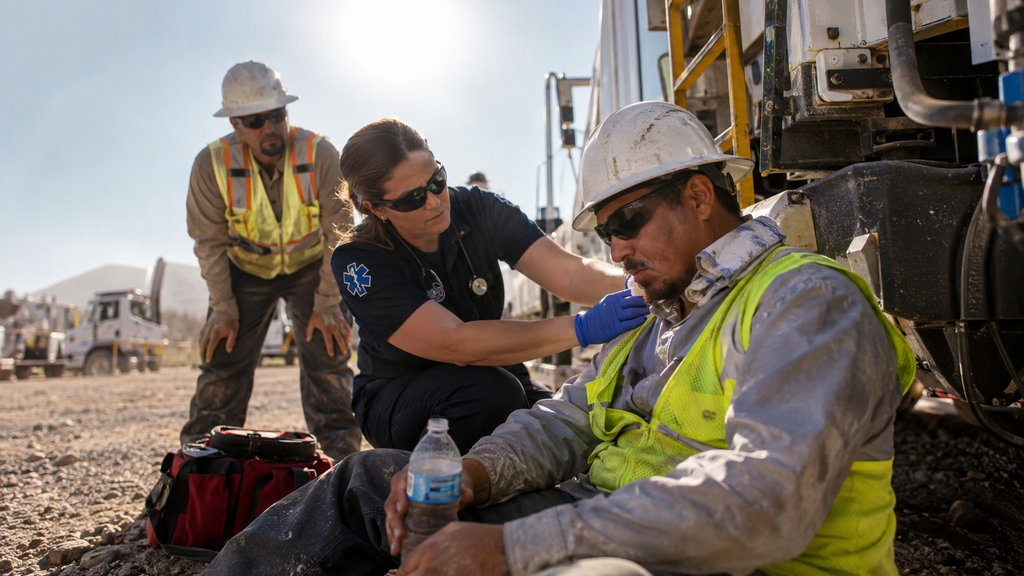
A first aid kit does not become a heat response system just because the temperature rises. Neither does placing a medic onsite. Outdoor heat risk becomes an operational problem when environmental conditions, physical workload, protective clothing, long shifts, remote access, or a workforce that is not yet acclimatized make a routine first aid response too thin for the exposure that actually exists.
For outdoor employers, oil and gas operators, mobile production teams, and other physically demanding worksites, the real question is whether the site can recognize heat illness early, move the worker to effective cooling, reach appropriate medical support, and arrange transport without delays caused by unclear roles or difficult access.
That is where onsite medic staffing can become part of a stronger readiness model. The medic is not a substitute for the employer’s heat safety program. The value is having a medically trained response layer positioned inside a worksite that already has prevention controls, communication rules, cooling resources, and a defined path to EMS when the situation exceeds what can be handled onsite.
| Direct Answer: An outdoor worksite should consider onsite medic staffing when heat exposure combines with factors such as strenuous work, long shifts, PPE, new or returning workers, remote geography, difficult site access, repeated heat related symptoms, or delayed EMS response. A medic should sit inside a broader heat plan, not replace it. Water, rest, shade or cooling, acclimatization, supervision, emergency communication, and transport readiness still need clear owners. |
For the broader emergency readiness framework, see the high risk worksite planning guide. The sections below stay centered on heat specific medical coverage.
Why Heat Changes the Medical Readiness Question
NIOSH describes occupational heat stress as the combined effect of environmental heat, metabolic heat from work, and the heat burden created by clothing or personal protective equipment. That matters because a thermometer by itself does not tell you how hard the body is working to shed heat. Direct sun, humidity, low air movement, heavy exertion, and PPE can change the risk profile even when two sites report the same air temperature. NIOSH Heat Stress and Workers
The staffing implication is simple: medical coverage should be based on the operating conditions that can develop during the shift, not only on the conditions present at the preshift meeting.
When a Basic First Aid Plan Starts to Look Too Thin?
There is no universal temperature, crew size, or distance from a hospital that automatically means a medic must be placed at a worksite. That would be a weak and potentially misleading rule. Instead, leaders should look for combinations of risk that reduce the margin for a delayed or improvised response.
- Sustained outdoor work in high heat, humidity, direct sun, or around additional radiant heat sources.
- Heavy physical work, repetitive lifting, climbing, carrying, or tasks that keep metabolic heat production high.
- Protective clothing or PPE that limits heat loss or must remain in place for the job.
- New workers, returning workers, or rotating crews who may not yet be acclimatized to the current heat exposure.
- Long shifts, overtime, schedule changes, or mobile assignments that reduce recovery time or change exposure conditions.
- Remote geography, controlled access sites, long internal travel distances, offshore or onshore industrial settings, or locations where EMS entry is not simple.
- A history of heat related symptoms, repeated first aid encounters, or work stoppages during similar conditions.
- A large or dispersed workforce where supervisors cannot directly observe everyone and communication paths are complex.
None of those factors proves that one particular staffing model is required. Together, however, they help answer a more useful question: if a worker becomes seriously ill right now, is the site’s current response layer fast, clear, and capable enough?
Use a Heat Readiness Coverage Matrix Instead of a Single Trigger
A practical planning matrix keeps the decision focused on consequence and response capability. The rows below are not legal thresholds or clinical protocols. They are questions a site can use when deciding whether first aid coverage, an onsite medic, EMS support, or added transport readiness deserves consideration.
| Risk signal | Why it matters | Medical readiness question |
| High environmental heat plus direct sun or humidity | Raises total heat load and can worsen quickly during the shift | Is there reliable cooling, trained recognition, and a clear escalation route if symptoms appear? |
| Strenuous work or heat trapping PPE | Adds metabolic and clothing related heat burden | Can the site identify symptomatic workers early and remove them from exposure without delay? |
| New or returning workers | Acclimatization may be incomplete | Who monitors higher risk workers, and what happens when symptoms or reduced tolerance appear? |
| Remote or difficult EMS access | Increases time between recognition and higher level care | Is a medic positioned close enough, and is ambulance or EMS access planned in advance? |
| Repeated symptoms or prior heat incidents | Shows that current controls may not be enough under similar conditions | What changed after the previous event, and is the response layer stronger now? |
| Large, mobile, or dispersed crew | Makes recognition, communication, and access harder | Does the medical coverage move with the work, or can it reach the worker quickly? |
The Medic Is a Response Layer, Not the Heat Program
NIOSH workplace recommendations emphasize engineering and work practice controls, training, hydration, rest breaks, acclimatization, and procedures for contacting emergency medical services. NIOSH Workplace Recommendations The employer and safety program still own prevention. A medic can support readiness, recognition, first response, documentation, and escalation within the clinician’s scope and the site’s approved protocols.
This distinction matters because it prevents a false sense of security. If workers do not have reasonable access to water, shade or cooling, recovery time, supervisor awareness, and a workable emergency plan, adding a medic does not erase the underlying exposure. The same is true if the site routinely extends shifts, changes locations, or adds PPE without updating the heat plan.
A strong setup gives each function a clear owner. Safety leadership manages prevention controls. Supervisors manage work practices and reporting. Workers are trained to recognize and report symptoms. The onsite medic handles the medical role assigned by credential, policy, and protocol. EMS or ambulance services take over when the event requires a higher level of care or transport.
Plan for Acclimatization Before the First Hot Shift
Acclimatization is one of the most important reasons a normal hot day can be more dangerous for one worker than another. NIOSH recommends gradually increasing heat exposure over roughly 7 to 14 days. For new workers, NIOSH recommends no more than 20 percent exposure on day one, increasing by no more than 20 percent on each additional day. Returning workers may adapt more quickly than new workers, although time away from hot conditions can reduce previous acclimatization. NIOSH Acclimatization Guidance
The staffing lesson is not that the medic should run the entire acclimatization program. Medical readiness should account for who is actually on the crew. A site with experienced, heat acclimatized workers may have a different risk profile from the same site after a large onboarding class, a long shutdown, a contractor change, or a rotation that brings in workers from cooler conditions.
At the planning stage, identify which crews are new or returning, who owns acclimatization, what supervisors should watch for, and how the medic or designated medical responder is notified when someone reports symptoms or cannot tolerate the planned workload.
Use Heat Index as a Screening Tool, Not a Clinical Cutoff
Heat index and weather forecasts are useful for planning, but they should not become the only number that decides medical coverage. NIOSH and OSHA use heat index information as a practical planning aid while also emphasizing that work intensity, direct sun, clothing or PPE, humidity, and individual factors can change actual heat stress.
Define the Medic’s Heat Response Workflow Before Symptoms Appear
The medic should not have to invent the process during an incident. Before the shift starts, the site should define what the medic can access, who can stop or modify work, how the medic contacts the safety lead, how 911 or local EMS is activated, where an ambulance can enter, and what documentation is required after an encounter.
- Preshift confirmation of the medical post, cooling location, communication method, site map, gate or access instructions, and emergency contact chain.
- Verification that first response and cooling supplies are available, maintained, and appropriate to the site plan.
- A clear method for workers and supervisors to request medical evaluation without unnecessary delay.
- Role specific assessment and first response by the medic within applicable scope, protocols, medical direction, and site requirements.
- A defined threshold for escalating to local EMS or ambulance transport based on symptoms, clinical concern, and the site’s approved emergency plan.
- Incident documentation that allows leaders to review what happened, how quickly the response moved, and whether the same risk is recurring.
The exact clinical protocol is not something a staffing blog should invent. The point is operational: the medic must know the pathway before the worker is already in distress.
Treat Suspected Heat Stroke as an Emergency
Heat stroke is the point where delay becomes especially dangerous. NIOSH lists confusion, altered mental status, loss of consciousness, seizures, very high body temperature, and other severe signs among heat stroke indicators. Its first aid guidance is direct: call 911, stay with the worker, move the person to a cooler area, remove outer clothing, and begin rapid cooling while emergency care is on the way. NIOSH Heat Related Illnesses
For staffing and site planning, the important part is not turning supervisors into clinicians. It is making sure everyone knows that suspected heat stroke is not a situation for observation and delay. The worker should not sit alone in a break room while the team debates whether symptoms are serious. The emergency communication and cooling pathway should already be established.
Decide When Transport Readiness Needs Its Own Layer
Some outdoor worksites have rapid local EMS access and straightforward entry. Others do not. A remote industrial location, large production footprint, controlled access site, mobile crew, or offshore or onshore operation can add time even when the emergency call itself is made promptly.
StaffDash’s Onsite Medics Staffing service includes onsite medics for oil and gas operations, set medic services, mobile set medics, incident data tracking and documentation, customized first aid kits, and standby ambulance options for productions with higher risk factors.
A standby ambulance is not automatically required whenever a site is hot. It becomes a planning question when consequence, access, or transport delay is high enough that relying only on normal community response may not match the site’s risk. For nonproduction worksites, leaders should evaluate their own geography, access, local EMS availability, applicable requirements, and emergency action plan before deciding on transport support.
Where broader prehospital coverage is needed, StaffDash also provides EMS staffing services that can support ambulance and EMS workforce needs beyond a single onsite medic role.
Document the Pattern, Not Just the Individual Incident
A heat related encounter should not disappear into a one line note that says a worker was treated and returned. The useful question is whether the event reveals a pattern. What task was underway? What time did symptoms appear? Was the worker new or returning? What protective clothing was being worn? How far was the worker from cooling? Was the same area involved in earlier events? Did the response require EMS or transport?
StaffDash’s medics service identifies data tracking and incident documentation as part of its onsite offering. That makes documentation a legitimate part of the staffing conversation, provided employers maintain appropriate privacy, recordkeeping, and policy controls.
Use Escalation Tiers Instead of a Medic or No Medic Decision
- Baseline prevention layer: heat plan, training, water, cooling or shade, acclimatization, supervision, communication, and emergency access.
- Enhanced response layer: a designated medically trained responder or onsite medic positioned where the work and risk justify faster evaluation and escalation.
- Higher consequence layer: onsite medic coverage plus dedicated EMS or standby ambulance planning when geography, access, activity, crew size, or incident profile justifies additional transport readiness.
- Operational management layer: centralized scheduling, attendance visibility, credential and readiness tracking, and replacement coordination when multiple medics, shifts, or sites must stay covered.
For organizations operating multiple sites or rotating medical teams, onsite staffing management can help centralize workforce coordination so heat response coverage does not depend on one supervisor tracking every shift, credential, and replacement manually.
Current OSHA Context: Do Not Turn a Proposed Rule Into a Published Requirement
As of September 2026, OSHA’s Heat Injury and Illness Prevention in Outdoor and Indoor Work Settings rule remains a proposed rule, not a final federal heat standard. OSHA also updated its National Emphasis Program for outdoor and indoor heat related hazards on April 10, 2026, directing inspection and outreach attention toward higher risk industries and heat priority conditions. OSHA Heat Rulemaking OSHA Heat National Emphasis Program
That distinction matters for E E A T. A StaffDash article should not tell readers that a new federal heat rule already requires a particular staffing ratio, medic placement, temperature trigger, or break schedule.
Employers should evaluate the federal rules that apply to their operation, state or local requirements, contractual obligations, site specific hazards, and qualified safety or legal guidance where needed.
Heat Stress Medical Coverage Readiness Checklist
- Define the heat exposure: temperature or heat index, humidity, direct sun, radiant heat, workload, PPE, and shift duration.
- Identify workers who are new, returning, rotating, or otherwise not fully acclimatized to current conditions.
- Confirm ownership of water, cooling or shade, rest, work practice changes, and supervisor monitoring.
- Decide whether a first aid response is enough for the site’s consequence and access profile.
- If using an onsite medic, define scope, communication, supplies, location, mobility, documentation, and escalation expectations before the shift.
- Map the EMS route: gates, access points, coordinates, site contacts, staging areas, and likely transport destination processes.
- Decide whether higher consequence operations need standby ambulance or other transport readiness.
- Document heat related encounters and review patterns without turning operational reports into unnecessary repositories of sensitive medical details.
- Reassess the plan when weather, workforce, PPE, shift length, job task, worksite location, or local EMS access changes.
How StaffDash Can Support the Next Step?
StaffDash supports employers and production teams that need medical coverage beyond a basic first aid response. Available services include onsite medics for oil and gas operations, set and mobile medics, incident documentation, customized first aid kits, and standby ambulance options for productions with higher risk factors.
| READY TO STRENGTHEN HEAT EXPOSED WORKSITE MEDICAL COVERAGE? Talk with StaffDash about onsite medic staffing, EMS support, and transport readiness options that fit the actual site, crew, access profile, and risk. Contact StaffDash |
Frequently Asked Questions
When should an outdoor worksite consider onsite medic staffing?
Consider it when heat exposure combines with strenuous work, PPE, long shifts, new or returning workers, remote geography, complex access, a large or mobile workforce, repeated heat related symptoms, or other conditions that reduce the margin for delayed medical evaluation. The decision should be site specific rather than based on one universal temperature or crew size rule.
Does an onsite medic replace a heat illness prevention program?
No. The employer still needs appropriate prevention controls, training, hydration, cooling or shade, rest and work practice planning, acclimatization, supervision, communication, and emergency procedures. The medic is a medical response and escalation layer within that broader system.
What should happen if heat stroke is suspected?
NIOSH treats suspected heat stroke as a medical emergency. Call 911, stay with the worker, move the person to a cooler area, remove outer clothing, and begin rapid cooling while emergency medical care is on the way, following the site’s emergency plan and trained medical guidance.
Does OSHA currently require every hot outdoor worksite to have an onsite medic?
No. There is currently no blanket federal OSHA requirement that every hot outdoor worksite maintain an onsite medic. OSHA’s federal heat injury and illness prevention rule remains proposed. Employers should evaluate the OSHA standards, state requirements, contractual obligations, emergency plans, and worksite hazards that apply to their specific operation.
Why does acclimatization matter when planning medical coverage?
Workers who are new to the heat or returning after time away can have lower heat tolerance. NIOSH recommends a gradual acclimatization period and closer attention to new and returning workers. A staffing and response plan should therefore consider who is actually on the crew, not just the forecast.
When should a worksite consider standby ambulance support?
There is no universal trigger. Consider transport readiness when site access, remote geography, activity risk, crew size, or the consequences of delayed care make normal community response less aligned with the operation’s needs. StaffDash specifically lists standby ambulance options for productions with higher risk factors on its medics service page.
The Bottom Line
A heat exposed worksite needs more than supplies and good intentions. It needs prevention controls, a trained workforce, a clear medical response pathway, access to cooling, defined escalation, and a realistic transport plan. Onsite medic staffing becomes valuable when the site’s heat load, workforce profile, geography, or operational complexity makes a basic first aid model too fragile. The medic should strengthen the system, not become the system.