
Quick Answer: A medical receptionist staffing agency can help a clinic fill a front desk vacancy, leave, schedule gap, or recurring coverage need. The strongest request does more than ask for a receptionist. It defines when coverage is needed, which communication channels the receptionist owns, which systems are required, what information can be handled at the desk, and where clinical or financial questions must be transferred. This turns a general front desk opening into an assignment a candidate can understand before the first shift.
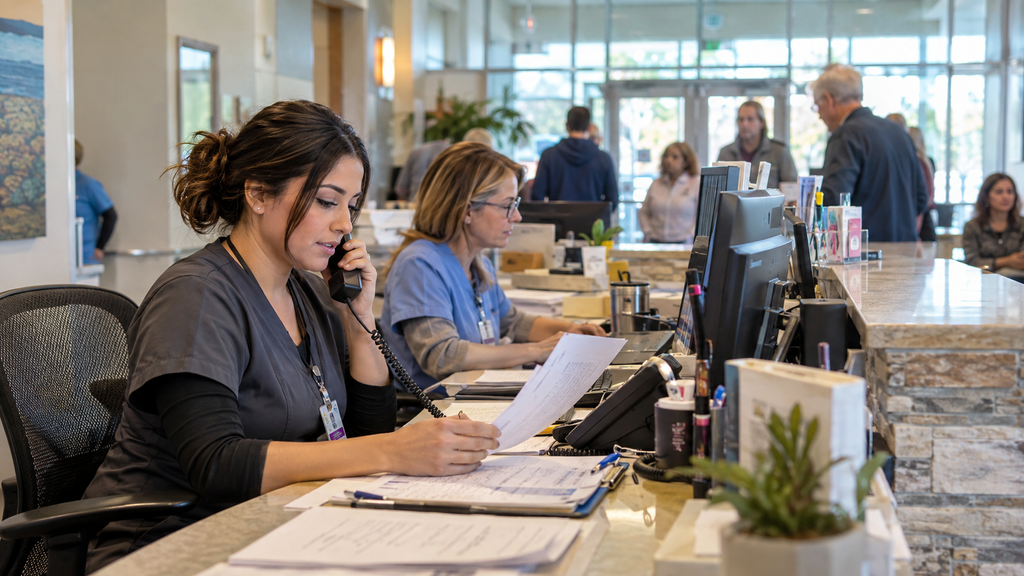
A clinic receptionist may be greeting an arriving patient while the phone rings, a message waits, another patient needs directions, and the schedule changes in real time. The problem is not simply that the front desk is busy. The problem is that several channels compete for the same person’s attention, often at predictable times.
That makes receptionist staffing different from a broad patient access strategy. A patient access program can include scheduling, intake, insurance verification, referrals, call centers, and other functions. This article focuses on the narrower staffing decision: what should one receptionist or front desk assignment actually cover, and what must the clinic define before asking someone to step into it?
1. Define the Coverage Window Before the Job Description
Start with time. A clinic may need a full day receptionist, but many front desk problems are concentrated around opening, lunch coverage, provider session changes, late afternoon calls, or specific high volume days. A staffing request becomes more useful when it identifies the hours that create the operational gap.
Review the clinic day in practical blocks:
- Opening and first patient arrivals
- Morning phone and appointment activity
- Lunch and staggered break coverage
- Afternoon arrivals and schedule changes
- End of day calls, messages, and checkout related handoffs
- Evening or weekend coverage when the clinic operates outside standard hours
The goal is not to invent a universal receptionist ratio. It is to show when the clinic needs another person and what is happening during that window.
2. Build a Front Desk Channel Map
A receptionist assignment becomes clearer when the clinic identifies the channels competing for attention. Instead of measuring only how many people are scheduled at the desk, map what is arriving through each channel and decide who owns it during the coverage period.
| Channel | Typical receptionist work | Needs clinic rule | Handoff trigger |
| Front desk | Greet arrivals, confirm basic visit information, direct patients | Arrival and check in procedure | Question requires clinical judgment or another department |
| Telephone | Answer, route, take messages, provide approved general information | Call routing and message standard | Symptoms, urgent concerns, or clinical advice |
| Scheduling | Schedule or confirm appointments within approved rules | Appointment types, provider rules, booking authority | Request falls outside approved scheduling rules |
| Messages | Record and route patient or internal messages | Required fields and destination | Message needs clinical review or escalation |
| Administrative updates | Enter approved demographic or contact information | Data entry and verification procedure | Information requires insurance, billing, or records expertise |
This map creates priorities without pretending every front desk task has the same urgency. It also prevents a new receptionist from guessing whether to keep answering calls, finish an arrival, change an appointment, or route a question to someone qualified to handle it.
3. Match the Candidate to the Actual Reception Environment
The U.S. Bureau of Labor Statistics describes receptionist work that includes answering phones, scheduling and confirming appointments, greeting visitors, entering information, and maintaining records. It also notes that receptionists in hospitals and physician offices may collect patient information. Those duties support the basic role, but a clinic still needs to define its own assignment.U.S. Bureau of Labor Statistics receptionist profile
Candidate matching should reflect the environment the person will enter. Useful requirements can include:
- Recent medical office or healthcare reception experience when the clinic requires it
- Experience with the clinic’s scheduling or practice management environment
- Comfort handling simultaneous phone and in person activity
- Knowledge of the clinic’s appointment types or the ability to learn them during orientation
- Communication requirements, including languages when genuinely required for the assignment
- Schedule availability for the actual coverage window
- Clear understanding of which questions must be transferred rather than answered at the desk
4. Separate Reception Work From Clinical Judgment
Front desk staff can receive questions that sound administrative until the patient adds a symptom, medication concern, urgent change, or request for clinical advice. The receptionist assignment should make that boundary visible.
The clinic should define how staff route symptom calls, urgent concerns, medication questions, test result questions, and other matters that require clinical review. Receptionists can document and route according to the clinic’s procedure, but they should not be positioned as substitutes for qualified clinical staff.
This distinction also protects the receptionist. A person can provide excellent service without being expected to solve every question that reaches the front desk.
5. Decide Which Scheduling Decisions the Receptionist Can Make
Scheduling is one of the easiest places for a front desk role to become unclear. A clinic may have different visit lengths, provider preferences, location rules, new patient requirements, procedure slots, referral requirements, or same day instructions.
Before coverage begins, define:
- Which appointment types the receptionist may schedule
- Which changes can be made without supervisor approval
- What information must be collected before a slot is confirmed
- How cancellations and rescheduling are documented
- Where urgent scheduling requests are routed
- What happens when the requested appointment does not fit an approved scheduling rule
A receptionist who knows the scheduling boundaries can work more independently without being forced to improvise clinic policy.
6. Make First Day System Access Practical
A receptionist who cannot log in, see the schedule, answer the assigned phone line, or document a message is present but not fully usable. First day readiness should focus on the tools required for the exact front desk assignment.
Depending on the clinic, that can include:
- Practice management or scheduling system access
- Approved patient registration functions
- Telephone and messaging tools
- Secure communication tools used by the clinic
- Approved scripts, directories, and routing instructions
- Basic orientation to locations, providers, appointment types, and escalation contacts
The healthcare organization remains responsible for granting appropriate access and defining what the receptionist may view or change. Staffing support should fit inside those controls.
7. Use a First Hour Handoff Instead of a Generic Orientation
A short operational handoff can prevent the first shift from becoming trial and error. The person starting the desk should know what is already in motion before the first patient or call is transferred to them.
A useful first hour handoff can cover:
- Which providers and locations are active during the shift
- Known schedule changes or arrival issues
- Which phone lines and message queues the receptionist owns
- Who handles clinical escalation
- Who handles billing, insurance, records, or authorization questions
- Break coverage and who takes over the desk
- Any temporary workflow change that applies that day
This is deliberately different from a broad patient access checklist. It is a shift level handoff for the receptionist who is about to operate the desk.
8. Choose the Staffing Duration From the Coverage Problem
Not every front desk gap needs the same employment model. A short leave, a vacancy, an extended recruiting period, a new location, or a recurring schedule problem can point to different staffing needs.
A temporary assignment may fit a defined absence or transition. A temporary to permanent arrangement may fit a clinic that wants to evaluate long term role fit. Direct hire may make more sense when the receptionist position is stable and intended to remain part of the permanent team.
The clinic should make that decision from the duration of the coverage problem rather than using temporary staffing indefinitely without reassessment.
How StaffDash Fits Medical Receptionist Staffing?
StaffDash publicly includes receptionists and front desk roles within its nonclinical healthcare staffing scope. That makes medical receptionist staffing directly aligned with the company’s published services.staffing services
A strong request to StaffDash should identify the clinic setting, coverage window, front desk channels, scheduling responsibilities, required systems, experience requirements, assignment duration, and handoff rules. The clinic retains authority over its scheduling policies, patient information procedures, system permissions, clinical escalation rules, and final supervision. StaffDash can support candidate sourcing and placement within that defined assignment.
Frequently Asked Questions
What does a medical receptionist staffing agency do?
A medical receptionist staffing agency helps healthcare organizations recruit or place reception and front desk professionals for defined temporary, temporary to permanent, or direct hire needs. The clinic should still define the schedule, systems, responsibilities, access, and escalation rules.
When should a clinic consider supplemental receptionist staffing?
Supplemental coverage may fit a vacancy, leave, recruiting period, new location, schedule expansion, or a recurring coverage window where front desk workload exceeds the available team.
What should a medical receptionist staffing request include?
Include the clinic setting, coverage hours, phone and front desk responsibilities, scheduling authority, required systems, relevant experience, communication requirements, assignment duration, and the people who receive clinical or specialized administrative escalations.
Can a medical receptionist answer clinical questions?
A receptionist can document and route questions according to clinic procedures, but clinical assessment and advice should be handled by appropriately qualified clinical staff.
How is this different from patient access staffing?
Patient access can cover a broader set of functions such as intake, scheduling, verification, referrals, call centers, and coordination. Medical receptionist staffing focuses on the specific front desk role, its coverage window, channels, systems, and handoffs.
The Bottom Line
A medical receptionist staffing request should describe more than a vacant chair at the front desk. Clinics get a clearer assignment when they define the coverage window, channel ownership, scheduling authority, systems, escalation boundaries, and first shift handoff before the candidate arrives.
That level of definition helps the clinic evaluate whether it needs short term coverage, a longer assignment, or a permanent receptionist while keeping the role separate from broader patient access strategy and clinical decision making.
If your clinic needs front desk coverage for a vacancy, leave, schedule gap, or permanent opening, contact StaffDash with the coverage hours, responsibilities, systems, experience requirements, and expected assignment duration.