
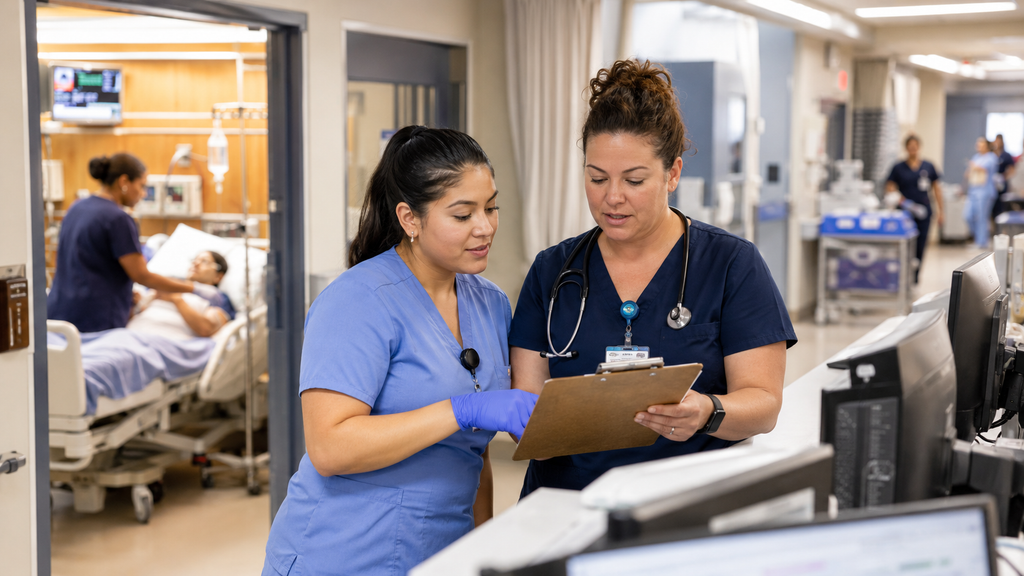
A CNA (Certified Nursing Assistant) can be fully cleared for employment and still be the wrong person for a specific hospital shift. The credential may be valid. The background file may be complete. The schedule may show full coverage. None of that proves the worker is ready for the patient population, physical demands, documentation workflow, supervision model, equipment, or pace of the unit.
That is the gap hospitals need to manage. CNA staffing is not only a question of how many people are available. It is a question of whether the right nursing-assistant support is ready for the exact work that will be assigned.
StaffDash explicitly lists certified nursing assistants within its clinician staffing services. For hospital leaders, the strongest staffing request starts with the unit and the work, not a generic request to “send a CNA.”
| DIRECT ANSWER A hospital CNA is unit ready when the facility has defined the approved duties, verified assignment specific qualifications, matched recent experience to the unit, confirmed safe patient handling readiness, completed access and orientation, and identified the supervising RN and escalation path. A filled schedule should not count as reliable coverage until those conditions are complete. |
|---|
A CNA Title Does Not Describe the Assignment
Two hospital shifts can carry the same CNA title and require very different preparation. An adult medical-surgical assignment may emphasize mobility, toileting, vital signs, intake and output, and frequent admissions or discharges. An orthopedic or rehabilitation unit may place heavier demands on transfer technique and mobility equipment. An emergency department may move faster and require a worker who is comfortable with rapid turnover and frequent escalation.
Behavioral-health observation, one to one monitoring, phlebotomy, ECGs, glucose testing, transport, or other support functions should never be assumed from the title alone. Some organizations may assign selected tasks to CNAs or patient care technicians when law, training, competence, policy, and delegation permit. Others may use separate roles.
The staffing brief should therefore describe the work the facility has approved, not the broadest list of tasks a nursing assistant might perform somewhere else.
Use a Unit Ready CNA Coverage Matrix
The matrix below is designed to answer one operational question before a shift is offered: what must be true for this worker to support this unit without shifting hidden workload back to licensed nurses?
| Matrix field | What the hospital defines | What the staffing match must prove |
|---|---|---|
| Unit and patient population | Med-surg, ED, telemetry, orthopedics, rehab, behavioral health, float pool, or another client-defined area. | Recent experience is relevant to the pace, patient needs, and support model. |
| Approved support tasks | Bathing, toileting, feeding, ambulation, transfers, vital signs, intake/output, specimen support, room readiness, or other authorized duties. | Candidate training and recent work support the actual task list. |
| Explicit exclusions | Tasks reserved for licensed nurses or separately qualified staff. | The worker understands what not to do and when to escalate. |
| Physical and handling demands | Lift devices, two-person assists, bariatric needs, frequent repositioning, walking distance, standing, transport, and equipment. | Workers can meet the physical assignment safely and have the required training. |
| Documentation and technology | EHR flowsheets, handheld devices, communication tools, timekeeping, barcode or unit systems where applicable. | Access and orientation are complete before independent work. |
| Infection-prevention environment | PPE, isolation workflow, cleaning responsibilities, exposure reporting, occupational-health requirements. | The worker knows the facility process and has required supplies/access. |
| RN supervision and escalation | Named RN/supervision structure, assignment changes, urgent reporting, competency concerns. | The worker knows who owns clinical decisions and how to report concerns. |
| Backup / replacement path | What happens after a call-out, mismatch, removal from assignment, or workload change. | The staffing process can respond without restarting from zero. |
Separate Eligibility From Unit Readiness
Hospitals often treat credential clearance as the finish line. It is only one layer.
| Layer | Question | Example evidence |
|---|---|---|
| Eligibility | Can this person legally and contractually be placed for the defined assignment? | Identity/work authorization, applicable certification or registry status, background requirements, exclusion screening, health requirements, other client required records. |
| Role fit | Has the person recently performed the type of support work this unit needs? | Employment history, reference checks, unit exposure, task frequency, schedule history, structured interview. |
| Unit readiness | Can the person function in this hospital environment on the first independent shift? | Badge, documentation access, equipment orientation, PPE/isolation process, escalation contacts, unit workflow. |
| Ongoing fit | Is the assignment working after placement? | Attendance, RN/unit feedback, task fit, handoff quality, documentation corrections, replacement needs. |
HHS-OIG maintains the List of Excluded Individuals/Entities and states that healthcare organizations should routinely check the list because excluded individuals or entities cannot receive payment from federal healthcare programs for covered items or services and hiring them can create civil monetary penalty exposure. HHS-OIG Exclusions Program
Exclusion screening is one part of eligibility. It does not prove unit competence, physical readiness, or appropriate delegation.
Do Not Import Nursing Home Registry Rules Into Every Hospital Assignment
Nursing assistant requirements vary by state, setting, employer, and task. BLS notes that nursing assistants often complete a state-approved education program and pass a competency exam to become licensed or certified, but that broad occupational description does not establish one universal hospital registry rule. U.S. Bureau of Labor Statistics nursing-assistant profile
Hospitals should verify the actual jurisdiction and facility requirements for the assignment instead of assuming that a requirement associated with one setting automatically applies to every hospital role.
Make Safe Patient Handling Part of the Staffing Match
A CNA assignment can be a physical job specification as much as a credential specification. If the unit routinely requires repositioning, transfers, ambulation, lift devices, or two person assistance, the request needs to say so before recruitment.
OSHA reports that more than half of injuries and illnesses reported among nursing assistants in 2020 were musculoskeletal disorders. OSHA’s hospital guidance recommends structured safe-patient-handling programs, including policies, equipment, training, assessment, and program evaluation. OSHA Safe Patient Handling guidance
That means the staffing decision should confirm more than willingness. The worker must understand the facility’s lift policy, team-assist rules, equipment, stop-work expectations, and escalation process. A busy unit is not a reason to improvise a transfer outside policy.
A Temporary CNA Needs the Same Infection-Prevention Expectations as the Unit
Temporary and contract status do not create a separate infection-prevention standard. CDC states that Standard Precautions are used for all patient care and include hand hygiene, risk-based PPE, respiratory hygiene, proper handling of patient-care equipment and textiles, and appropriate environmental practices. CDC Standard Precautions
Before the first shift, confirm access to required PPE, the unit’s isolation workflow, occupational-health clearance, exposure reporting, equipment-cleaning responsibilities, and any assignment-specific training. “Experienced CNA” is not evidence that the worker knows this hospital’s process.
RN Supervision Must Be Visible, Not Implied
Hospital CNA coverage sits inside the nursing service. Federal Conditions of Participation require hospitals to maintain adequate nursing personnel, require RN supervision and evaluation of nursing care, and require patient assignments to reflect patient needs and the qualifications and competence of available staff. The regulation also requires supervision of nursing personnel regardless of whether they are hospital employees or contract workers. 42 CFR 482.23
The rule does not create a universal CNA ratio. It does reinforce why the staffing plan must identify the supervising RN, clarify what can be assigned, and provide a practical route for reporting changes in condition, falls, abnormal findings, patient refusal, mobility problems, safety concerns, or tasks outside the worker’s competence.
Track Licensed Nurse Backfill as a Hidden CNA Coverage Signal
A CNA gap does not stay inside the CNA schedule. When support capacity is weak, licensed nurses often absorb basic-care and support work. That may be appropriate in the moment, but repeated backfill should be measured instead of treated as invisible capacity.
Track licensed-nurse hours spent covering routine CNA functions by unit and shift. The number is not proof that more CNAs are always the answer. It is a signal that the support model deserves review.
| Signal | What it may indicate | What to check before adding staff |
|---|---|---|
| Repeated RN/LPN support backfill | CNA coverage, task mix, or schedule mismatch. | Actual CNA coverage, allowed duties, workload peaks, documentation, unit layout. |
| Frequent late admissions/turnover support | Coverage does not match unit flow. | Shift start times, discharge/admission peaks, room-readiness workflow. |
| Transfer/mobility delays | Insufficient trained handling capacity or equipment access. | Lift availability, two-person rules, worker competence, patient needs. |
| High cancellation/replacement rate | Poor assignment match or weak readiness process. | Unit description, candidate screening, orientation, schedule reliability. |
| Many cleared candidates fail first shift | Credentialing is being mistaken for readiness. | Access, workflow, equipment, supervision, expectations, unit match. |
Use a First Shift Readiness Gate
Do not count a candidate as usable hospital coverage until the unit can answer yes to the following:
- The approved CNA duties and exclusions are written for this unit.
- Required eligibility, verification, screening, and facility records are complete.
- Recent experience matches the unit, schedule, physical demands, and patient population.
- Badge, documentation, communication, and required equipment access work.
- Safe-patient-handling and infection-prevention expectations have been reviewed.
- The supervising RN or unit contact is identified.
- The worker knows which findings and events require immediate escalation.
- Timekeeping, breaks, handoff, documentation, incident reporting, and call-out procedures are clear.
If a hospital wants a broader facility-wide framework for licensure, screening, onboarding, and placement readiness, StaffDash already has a healthcare staffing compliance checklist. The CNA article should remain the unit-specific implementation resource.
High Need Units Require Better Matching, Not Broader Claims
A “high-need unit” should not be treated as a universal category. The staffing challenge depends on what creates demand in that environment.
| Unit context | Possible CNA support pressure | Matching question |
|---|---|---|
| Adult med-surg / telemetry | Frequent basic-care needs, mobility, vital signs, admissions/discharges. | Has the worker recently supported comparable acute-care volume and documentation? |
| Orthopedics / rehabilitation | Transfers, ambulation, repositioning, mobility equipment. | Is safe-handling experience current and aligned with the unit’s equipment/policies? |
| Emergency department | Rapid turnover, high variability, frequent escalation, room flow. | Does the worker have relevant acute-care experience and understand the approved ED support role? |
| Behavioral-health / observation use case | Continuous observation or behavior-related safety support if the client specifically assigns it. | Is observation part of the approved CNA assignment, and are training/supervision requirements defined? |
| Float pool | Changing units, workflows, and patient populations. | Which units is the person actually approved and competent to support? |
The point is not to advertise every possible CNA function. It is to make the assignment precise enough that StaffDash can screen against it.
Choose the Staffing Model Somewhere Else; Keep This Page About Readiness
A same-day call-out, a six-week leave, a recurring night-shift gap, and a permanent vacancy may require different employment models. StaffDash already has a dedicated article comparing per diem, temp-to-permanent, and permanent healthcare staffing. Repeating that full decision here would create unnecessary overlap.
Once the hospital chooses the model, the CNA readiness question is the same: can this specific person support this specific unit on the first independent shift?
What to Put in a Hospital CNA Assignment Brief?
- Facility, unit, patient population, and shift.
- Coverage reason and expected duration.
- Approved duties and explicit exclusions.
- Required certification, registry status, training, or other jurisdiction/facility requirements.
- Required recent hospital/unit experience and trainable gaps.
- Physical demands, lift equipment, two person assist expectations, and mobility workload.
- Documentation/EHR, communication devices, badge, timekeeping, and unit access.
- PPE, infection-prevention, occupational health, and exposure reporting requirements.
- Supervising RN/unit contact, delegation model, and escalation expectations.
- Orientation format and what must be complete before independent work.
- Attendance, cancellation, replacement, feedback, and first shift review process.
How StaffDash Fits?
StaffDash publicly lists certified nursing assistants among the clinicians it recruits and supports temporary, permanent, and project clinician staffing. It also has a dedicated hospital and emergency room staffing pathway for facilities managing acute and high-pressure coverage needs. hospital and emergency-room staffing services
The safest service claim is straightforward: StaffDash can help source and match CNA candidates to a client-defined assignment. The hospital retains responsibility for staffing levels, patient assignment, delegation, supervision, scope, unit policy, competency approval, and clinical governance.
The Bottom Line
A hospital does not have reliable CNA coverage simply because the schedule has a name in every box. Coverage is reliable when the worker is eligible, matched to the unit, trained for the actual support duties, ready for the physical and infection-prevention environment, connected to the supervising RN, and able to document and escalate correctly.
That is the difference between filling a shift and creating usable patient support capacity.
Need CNA coverage for a hospital unit, planned leave, recurring gap, or high volume schedule? Contact StaffDash with the unit, shift, approved duties, required experience, physical demands, supervision model, orientation requirements, and start date so screening begins with the real assignment.
Frequently Asked Questions
What is hospital CNA staffing readiness?
Hospital CNA staffing readiness means confirming that a nursing assistant is eligible for placement, matched to the specific unit and duties, prepared for the physical and infection-prevention environment, able to access required systems, and clear on RN supervision and escalation before independent work begins.
Is a CNA staffing agency different from a general healthcare staffing agency?
A facility looking for CNA support should evaluate whether the staffing provider actually recruits nursing assistants and can screen for the hospital setting, unit, schedule, credentials, physical demands, and client-defined competencies. A generic healthcare label does not prove role-specific capability.
Can one CNA job description work for every hospital unit?
No. Unit pace, patient population, physical demands, documentation, equipment, supervision, and permitted tasks vary. Hospitals should create assignment-specific requirements rather than rely on one generic description.
Does a CNA replace an RN or LPN?
No. CNAs provide approved support functions within applicable law, training, competence, hospital policy, delegation, and supervision. They do not replace licensed nursing assessment, judgment, care planning, or required supervision.
Must every hospital CNA be on a nurse aide registry?
Not necessarily. Requirements vary by state, setting, employer, title, and duties. Hospitals should verify the exact jurisdiction and facility requirements for the assignment rather than applying nursing-home rules universally.
What should be completed before an agency CNA starts a hospital shift?
At minimum, confirm the assignment duties, required eligibility and verification, unit fit, access, orientation, physical-handling expectations, infection-prevention process, supervising RN, documentation requirements, and escalation pathway.
How should hospitals measure whether CNA staffing is working?
Track staffing reliability and support capacity separately. Useful indicators include first-shift readiness, attendance, cancellations, replacement time, licensed nurse backfill, unit feedback, documentation corrections, safe handling issues, handoff quality, and whether assignments consistently match the unit’s approved work.
| Workforce planning disclaimer This article provides general staffing and workforce-planning information. It does not establish CNA staffing ratios, define state scope or registry requirements, authorize delegated nursing tasks, replace hospital policy, or guarantee patient, safety, compliance, operational, or financial outcomes. |
|---|