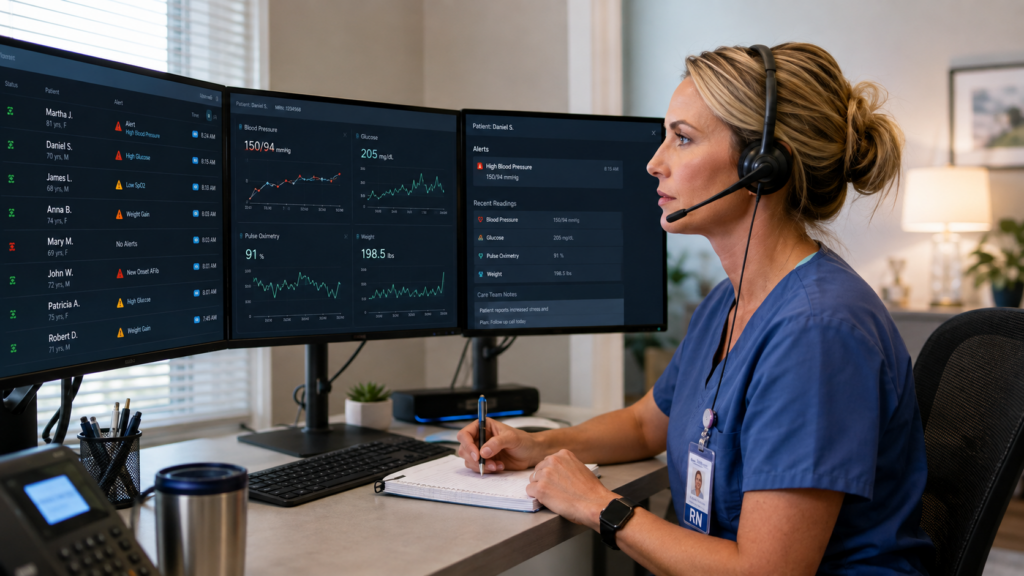
Remote patient monitoring (RPM) can scale quickly, but the operational work behind it does not disappear when a device starts transmitting data. Blood pressure readings, weight changes, glucose values, pulse oximetry, and other physiologic measurements still need an organized process for review, follow-up, documentation, and escalation. When patient enrollment grows faster than the team responsible for those tasks, the technology can create a new queue instead of reducing workload.
The Centers for Medicare & Medicaid Services (CMS) describes remote patient monitoring as the collection and automatic transmission of patient health data from connected medical devices to a healthcare provider. CMS also identifies treatment management as a core component: the data must be reviewed and used to manage the patient’s condition. That distinction matters. A successful RPM program is not simply a device program; it is a clinical operations program with people, protocols, ownership, and accountability behind the data.
For organizations with growing monitoring volume, remote U.S.-licensed RNs can provide additional clinical capacity for defined RPM workflows. Their role should be structured around the organization’s protocols, state scope of practice requirements, escalation rules, documentation standards, and clinical governance. The goal is not to replace the treating team. The goal is to make sure incoming data enters a reliable workflow rather than an unmanaged inbox.
Why RPM Alert Management Becomes a Staffing Problem?
RPM programs often begin with a manageable patient population and a small number of alerts. As enrollment expands, however, the workload can grow in several directions at once. More patients create more readings. More readings create more exceptions, follow-up calls, connectivity questions, documentation tasks, and escalations. Even when only a small percentage of readings require action, a large monitored population can produce a significant daily review burden.
The bottleneck is usually not the collection of data. It is the human work required to interpret the alert within an approved workflow, determine the next step, communicate with the patient when appropriate, document what happened, and close or escalate the item. If that work is added to an already full onsite nursing workload, alert queues can become inconsistent, delayed, or dependent on whoever has time that day.
Seven Common Failure Points in an RPM Alert Workflow
- Unclear ownership. When no role is explicitly responsible for a queue, alerts can sit between the vendor platform, nursing team, physician group, and care management department.
- Thresholds that are too broad. Poorly designed rules can generate high volumes of low-value notifications that compete for attention with genuinely important items.
- Systems are fragmenting. Staff may need to toggle between a monitoring dashboard, EHR, phone system and a messaging platform, increasing the potential for duplicate work and documentation.
- No escalation ladder. A nurse may recognize an abnormal reading but still require clear direction as to what constitutes routine outreach, same day clinical review or urgent escalation.
- Lack of coverage during predictable peaks. Weekends, mornings, post-discharge periods, and rapid enrollment campaigns can all lead to spikes in workload that a fixed team was not built to absorb.
- Weak closure rules. An alert may be reviewed but remain unresolved because no one owns patient contact attempts, repeat readings, clinician notification, or final documentation.
- No operational measurement. Without metrics like queue-aging, turnaround, contact and escalation, managers won’t see the problem until staff burn out or patients start complaining.
What Remote RNs Can Support in an RPM Program?
A well-designed remote RN model starts with a defined scope. Depending on the organization’s clinical protocols and the RN’s authorized role, remote nurses may support assigned alert queues, verify available context, conduct patient outreach, document interactions, reinforce device-use instructions, route non-clinical technical issues, and escalate abnormal findings to the appropriate clinician or care team.
StaffDash’s broader Virtual Care Continuum illustrates how remote nursing capacity can complement onsite teams across virtual clinical workflows. For RPM specifically, the most useful staffing model is one that gives remote nurses clear queue ownership and measurable responsibilities rather than treating them as an informal overflow resource.
A Practical RPM Alert Workflow
A scalable workflow can be organized into five operational stages:
- 1. Intake and prioritization: Incoming device data is routed according to organization-defined thresholds, patient-specific rules where applicable, and urgency categories.
- 2. Clinical review: An authorized team member reviews the assigned alert together with the information available in the approved system.
- 3. Patient follow-up: When the protocol calls for outreach, the nurse contacts the patient, confirms relevant information, documents the interaction, and provides only the guidance authorized by the organization’s workflow and scope rules.
- 4. Escalation: Findings that meet defined criteria are routed promptly to the designated clinician, provider, emergency pathway, or other responsible team.
- 5. Closure and reporting: The alert is closed only after required documentation, follow-up, and escalation steps are complete. Unresolved items remain visible for additional action.
The exact workflow will vary by patient population, device type, clinical program, and organizational policy. That is why staffing should follow the workflow design, not the other way around.
How to Determine Whether Your RPM Program Needs More Clinical Capacity?
Leaders should not wait for a large backlog before evaluating staffing. A basic capacity model can estimate workload using the number of enrolled patients, average alerts generated per patient, percentage of alerts that require human review, average handling time, patient-contact workload, documentation time, and expected coverage window. This does not need to be a perfect forecasting model; it needs to be good enough to show when demand is outgrowing available review hours.
Common warning signs include:
- Alert review time is increasing even though enrollment continues to grow.
- Onsite nurses are managing RPM work on top of full clinical assignments.
- The organization is slowing or pausing enrollment because the monitoring team cannot absorb more patients.
- Unresolved alerts, repeat outreach attempts, or documentation backlogs are rising.
- Coverage depends heavily on one or two individuals with no reliable backup.
- Leaders cannot clearly report how quickly alerts are reviewed, escalated, and closed.
When these conditions appear, additional healthcare staffing services may be more useful than adding another technology layer. The operational question is simple: does the program have enough qualified review capacity to match the volume it is generating?
Build the Escalation Model Before Adding Staff
More people cannot fix an undefined process. Before expanding the team, organizations should document who owns each alert category, expected review windows, patient-contact procedures, escalation thresholds, after-hours rules, documentation requirements, and backup coverage. High-risk or ambiguous situations should have a clearly identified clinical decision-maker.
The same principle applies to alert thresholds. If every minor variation generates a notification, adding staff may only make an inefficient workflow more expensive. Clinical and operational leaders should review threshold logic, duplicate alerts, device-specific patterns, and patient-specific considerations as permitted by the program. The objective is not to suppress important information; it is to make the queue usable and ensure attention is directed according to approved clinical priorities.
Security and Access Are Part of the Staffing Model
RPM workflows involve electronic health information, so remote staffing cannot be designed independently from privacy and security controls. The HHS summary of the HIPAA Security Rule explains that regulated entities must implement reasonable and appropriate administrative, physical, and technical safeguards for electronic protected health information. In practice, organizations should define role-based access, secure authentication, approved devices and communication channels, workforce authorization, auditability, and the minimum access necessary for the assigned role.
A staffing partner should be integrated into the organization’s approved access and compliance process rather than operating in a separate shadow workflow. Security requirements, confidentiality obligations, training, system permissions, and incident reporting expectations should be established before the first nurse begins reviewing patient data.
KPIs That Show Whether the RPM Workflow Is Working
A strong RPM staffing model should be measurable. The most useful metrics are not vanity metrics such as total readings received. Leaders need operational indicators that reveal whether important work is being completed consistently.
- Alert-to-review time: How long does it take for an assigned alert to receive initial review?
- Overdue alert volume: How many alerts exceed the organization’s defined review window?
- Patient contact rate: When outreach is required, how often is the patient successfully reached?
- Escalation rate and destination: What percentage of reviewed alerts require escalation, and where are they routed?
- Time to closure: How long does it take to complete required review, outreach, documentation, and escalation steps?
- Rework and duplicate activity: How often are multiple staff members handling the same issue unnecessarily?
- Unresolved queue age: Which items remain open, and why?
These metrics help distinguish a staffing problem from a workflow-design problem. For example, a growing queue may indicate insufficient RN capacity, but it can also reveal excessive alert thresholds, poor system integration, or unclear closure rules. Good reporting makes that distinction visible.
What Remote RNs Should Not Be Asked to Do?
Remote staffing is not a shortcut around clinical governance. A remote RN should not be expected to practice outside applicable licensure or scope requirements, independently create treatment plans when that is not part of the authorized role, bypass the organization’s escalation pathway, or make undocumented decisions from isolated device data. The organization remains responsible for defining the clinical model, access rules, supervision structure, and escalation responsibilities that apply to the program.
The most sustainable arrangement is therefore specific: defined work queues, defined protocols, defined documentation standards, and defined escalation ownership. That clarity protects patients, supports nurses, and makes performance easier to manage.
When External Remote RN Capacity Makes Strategic Sense?
External remote RN capacity can be useful when an organization is launching an RPM program, expanding enrollment, covering extended hours, managing a temporary backlog, adding a new patient population, or protecting onsite teams from a growing monitoring workload. It can also provide flexibility when the long-term workload is not yet predictable enough to justify a permanent internal hiring model.
The key is to add capacity before the alert queue becomes the program’s limiting factor. Technology can expand faster than an internal workforce. A staffing plan should therefore be part of the RPM growth plan from the beginning, alongside device selection, EHR integration, patient enrollment, clinical protocols, privacy, and reimbursement strategy.
Build an RPM Program That Can Scale Beyond the Pilot Stage
Remote patient monitoring delivers value only when incoming data leads to a consistent operational response. As enrollment grows, healthcare organizations need enough qualified people to review assigned alerts, communicate with patients, document actions, and escalate findings according to defined clinical rules. Without that capacity, the monitoring platform can become another source of backlog.
StaffDash can help healthcare organizations add flexible remote U.S.-licensed RN capacity for defined virtual-care and RPM workflows. A well-designed engagement starts with the work itself: patient volume, alert volume, coverage expectations, systems, protocols, documentation standards, and escalation responsibilities.
| Ready to strengthen your RPM alert workflow? Contact StaffDash to discuss scalable remote U.S.-licensed RN support for alert review, patient follow-up, documentation, and escalation under your organization’s defined protocols. |
Frequently Asked Questions
1. Who should review remote patient monitoring alerts?
RPM alerts should be reviewed according to a documented clinical and operational model. The responsible reviewer may be a nurse, physician, advanced practice clinician, care manager, or another appropriately authorized team member depending on the alert type, patient population, state requirements, and the organization’s protocols. The critical issue is not the job title alone; it is whether the person has the required qualifications, access, training, and escalation pathway for the assigned work.
Organizations should avoid a shared inbox with vague ownership. Every alert category should have a defined queue owner, review expectation, backup plan, and escalation destination so that responsibility does not depend on who happens to be available.
2. Can remote RNs manage RPM alerts and patient follow-up?
Yes, remote RNs can support RPM workflows when the assigned tasks are consistent with applicable licensure, scope-of-practice requirements, organizational policies, and clinical governance. Depending on the program, they may review assigned data, conduct patient outreach, document interactions, reinforce approved instructions, track unresolved items, and escalate findings to the designated clinician.
The organization should define what the RN can handle independently, what requires consultation, what requires urgent escalation, and where all actions must be documented. A clear protocol is more important than simply adding another person to the queue.
3. How many remote nurses does an RPM program need?
There is no universal nurse-to-patient ratio for RPM alert management because workload depends on the monitored condition, device type, alert thresholds, enrollment size, percentage of readings requiring review, average handling time, patient-contact frequency, documentation requirements, and hours of coverage. Two programs with the same number of enrolled patients can have very different staffing needs.
A practical starting point is to measure actual alert volume and handling time for several weeks, then model the clinical hours required to keep the queue within the organization’s expected review window. Capacity should also include time for outreach, documentation, escalations, meetings, training, and backup coverage rather than assuming every paid hour is available for direct alert handling.
4. What should an RPM escalation protocol include?
An escalation protocol should define alert categories, urgency levels, expected review times, patient-contact steps, repeat-reading procedures where applicable, the responsible clinician or service for each escalation level, after-hours instructions, emergency pathways, documentation requirements, and closure criteria. Staff should also know what to do when a patient cannot be reached or when device data conflicts with the patient’s reported condition.
The protocol should be approved by the organization’s appropriate clinical leadership and reviewed as the program changes. Staffing partners should work within that established framework rather than creating independent clinical rules.
5. How can healthcare organizations reduce RPM alert overload?
Start by identifying why the queue is growing. Common causes include thresholds that generate too many low-value alerts, duplicate notifications, unclear queue ownership, fragmented systems, incomplete patient onboarding, and insufficient review capacity. Adding staff may be appropriate, but it should not be the first or only response to an inefficient alert design.
Clinical and operational leaders should regularly review alert patterns, overdue items, rework, escalation rates, and unresolved cases. The aim is to create a workflow where clinically important information receives timely attention without forcing staff to repeatedly process unnecessary or duplicate tasks.
6. Does an RPM program need 24/7 nurse coverage?
Not every RPM program requires continuous nurse coverage. Coverage should reflect the clinical purpose of the program, monitored population, device and alert types, service commitments, organizational policies, and the escalation pathways available outside normal hours. Some programs operate within defined business hours, while others may need extended or continuous coverage because of their patient population or clinical model.
The important point is to set expectations clearly. Patients and staff should understand when data is reviewed, what situations require emergency services instead of waiting for an RPM response, and how after-hours alerts are handled.
7. How is RPM alert management different from general telehealth or telephone triage?
RPM alert management is driven primarily by incoming data from connected monitoring devices and the workflow required to review, document, follow up, and escalate that data. Telehealth is a broader category that can include scheduled video visits, virtual assessments, education, and other remote services. Telephone triage generally begins with a patient-initiated symptom call that must be assessed and routed.
These services can overlap operationally, but they should not be treated as the same workflow. Each requires its own staffing assumptions, protocols, documentation standards, and performance measures.