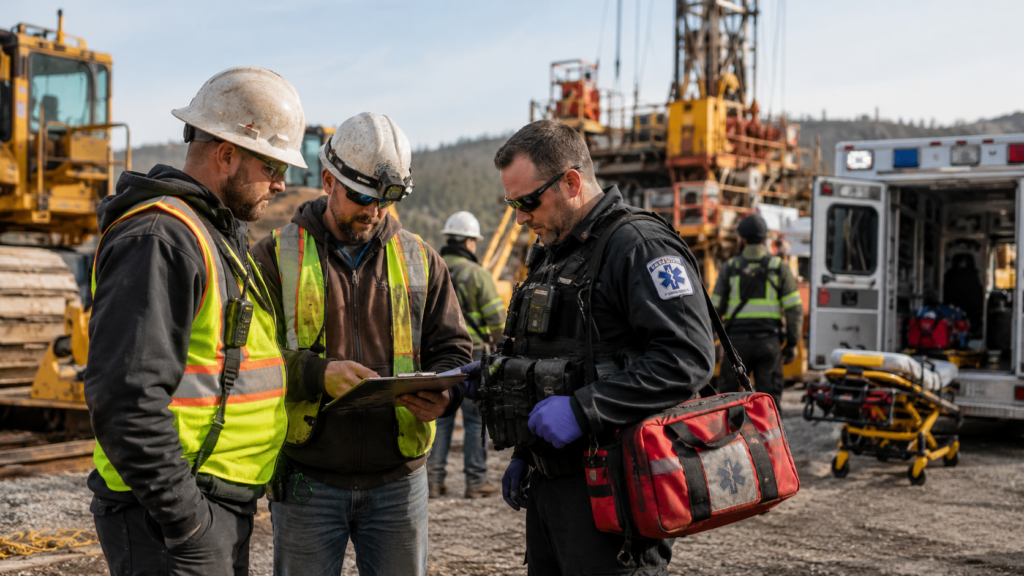
High-risk worksites should not wait for an incident before asking who is medically qualified to respond. If the plan is “call 911 and hope,” the plan is weak. Remote locations, production sets, oil and gas environments, mobile crews, and physically demanding worksites need clearer medical readiness.
This topic is one of the cleanest fits for StaffDash because the company has a dedicated On-Site Medics Staffing service page. That page references oil and gas companies, set medic services, drug and alcohol testing, data tracking and documentation, mobile set medics, first aid kits, and standby ambulance services. The blog should stay in that lane and not overclaim.
What Does an On-Site Medic Do?
An on-site medic supports a worksite by providing medical readiness, first response, incident documentation, first aid supply awareness, and escalation support when injuries or health issues occur. Depending on the setting, the medic may support a film set, mobile production, oil and gas site, high-risk corporate operation, or other worksite where medical response time matters.
On-site medic staffing is not the same as replacing a full emergency medical system. It is a readiness layer. The employer still needs site safety policies, emergency action plans, access routes, communication protocols, and appropriate escalation to EMS or ambulance transport when needed.
Which Worksites Need On-Site Medical Coverage?
- Oil and gas sites where crews may work in physically demanding or remote environments.
- Film, television, and production sets with mobile crews, long shoot days, stunts, heat exposure, or location movement.
- Adventure, reality, or travel productions where emergency access may be limited.
- High-risk industrial or construction-adjacent locations where injuries can escalate quickly.
- Large temporary worksites where staff, vendors, and equipment create moving risk.
StaffDash’s EMS staffing services and ambulance staffing services support the broader emergency-readiness context when the worksite may require more than a first aid presence.
The On-Site Medic Planning Checklist
1. Define the worksite risk profile
List the location, physical hazards, crew size, access routes, weather exposure, shift length, nearby emergency care, and activities that may increase medical risk.
2. Decide the right coverage level
Clarify whether the site needs a set medic, mobile medic, EMT, paramedic, first aid station, or standby ambulance support.
3. Prepare first aid and response supplies
StaffDash’s medics page references customized first aid kits. Supplies should match the site, crew, and likely incident profile.
4. Document every incident clearly
Incident documentation helps employers review patterns, improve safety planning, and support internal reporting.
5. Create escalation rules
Define when the medic treats on site, when supervisors are notified, when EMS is called, and when ambulance transport may be required.
6. Plan access before the shift starts
A medic who cannot reach the patient quickly is not enough. Access routes, gates, elevators, staging points, and communication channels matter.
7. Review drug and alcohol testing needs
Where appropriate and lawful, on-site drug and alcohol testing may support a safer work environment, but it must follow policy and applicable regulations.
Authority Context: First Aid and Worksite Safety
OSHA’s medical services and first aid standard is a useful authority reference for employers thinking about first aid availability and medical response planning. OSHA’s oil and gas extraction safety resources and NIOSH oil and gas safety information are also relevant when discussing higher-risk industrial environments.
This does not mean the blog should become a legal compliance article. It should remain a StaffDash-aligned staffing and readiness guide. The external links strengthen trust without pretending StaffDash replaces an employer’s safety team.
When Standby Ambulance Support Should Be Considered?
Standby ambulance support may be appropriate when the site has higher injury risk, limited access to nearby emergency care, remote geography, physically intense activity, or large crew/attendee volume. StaffDash’s on-site medics page specifically references standby ambulance services for higher-risk productions, so this is service-aligned.
The right question is not “Do we need a medic?” The right question is “What medical response layer fits this site, this risk, this crew, and this access reality?”
How StaffDash Supports On-Site Medic Staffing?
StaffDash can help employers and production teams evaluate on-site medic staffing, EMS support, ambulance standby, documentation needs, and first aid readiness. The strongest version of this blog is practical and sober: it helps teams plan before a medical incident, not after one.
For broader operational support, StaffDash’s onsite staffing management page can support workforce coordination context, while the dedicated medics and EMS pages anchor the medical-readiness angle.
FAQs
What is an on-site medic?
An on-site medic is a trained medical professional placed at a worksite, production, or event location to provide first response, medical readiness, incident support, and escalation coordination.
What worksites may need on-site medics?
Oil and gas sites, productions, mobile crews, remote worksites, high-risk events, and physically demanding workplaces may need on-site medic coverage.
Is an on-site medic the same as ambulance coverage?
No. An on-site medic provides immediate medical support at the site. Ambulance coverage may be needed separately when transport readiness or higher-risk response is required.
Can StaffDash support set medic services?
Yes, StaffDash offers set medic services, mobile set medics, first aid kits, incident documentation, and standby ambulance options on its on-site medics page.
What should employers plan before placing an on-site medic?
Employers should define site risk, access routes, escalation rules, incident documentation, supplies, communication channels, and when EMS or ambulance support is required.
If your worksite has real medical risk, hoping nothing happens is not a plan. Contact StaffDash to discuss on-site medics, EMS support, and standby ambulance options before the next shift begins. contact StaffDash