
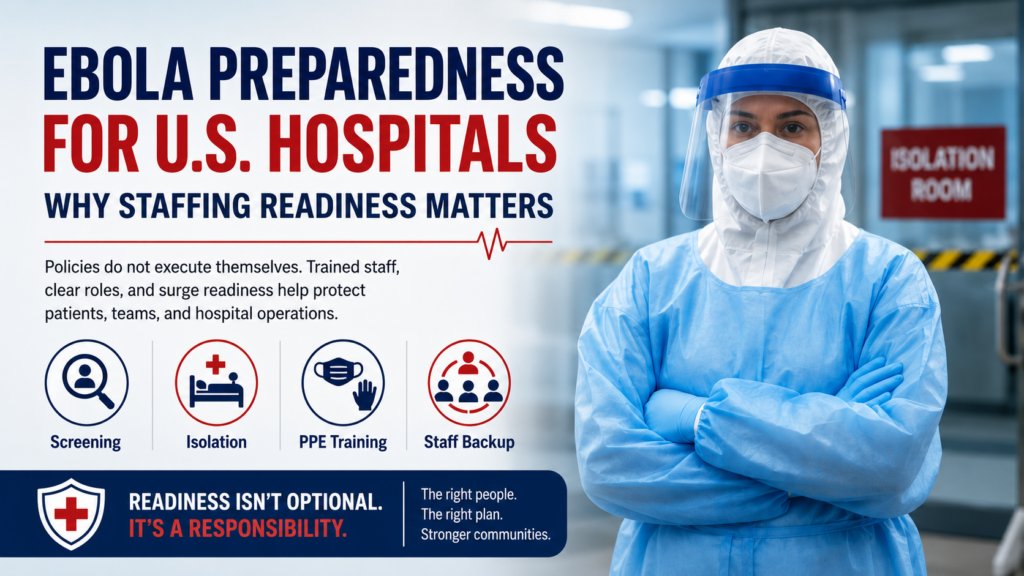
Ebola is not a daily U.S. hospital volume issue, but it is a high-consequence readiness test. The CDC says no outbreak-associated U.S. cases have been confirmed and public risk remains low; hospitals still cannot be casual. One suspected case can strain ER triage, isolation, PPE workflow, EMS handoff, and staffing continuity.
Policies do not execute themselves. A facility may have PPE, but it still needs trained people for screening, isolation support, patient flow, and backfill if staff are exposed, sick, or fatigued. That is where emergency room staffing becomes part of biosafety.
Preparedness starts with role mapping. Who screens exposure risk? Who alerts infection prevention? Who documents? Who coordinates transport? Who can enter restricted workflows? OSHA’s Ebola guidance reinforces hazard assessment, exposure controls, handwashing, PPE, and role-based protection.
Hospitals should connect medical staff services, EMS staffing, and temporary healthcare staffing before a suspected case appears. NETEC’s readiness assessments stress identify, isolate, inform, transportation, and operational readiness. Those steps require a trained staffing bench.
FAQ
What does Ebola preparedness mean for hospitals?
Trained staff, screening, isolation support, PPE workflow, EMS coordination, and backup coverage before a suspected case appears.
Why is Ebola a staffing issue?
Policies only work when trained, available people can execute them without breaking normal ER flow.
How can StaffDash help?
StaffDash helps facilities strengthen qualified coverage, credentialed roles, surge support, schedule resilience, and rapid replacement pathways. Contact StaffDash to review your staffing preparedness.