
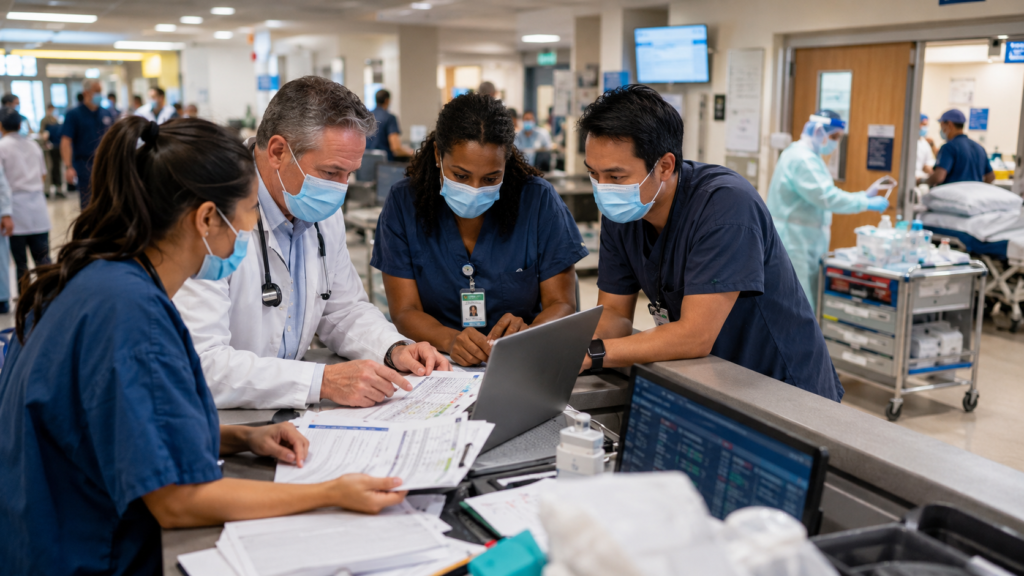
An ER surge staffing plan is not a motivational document. It is an operational safety tool.
If the plan only says ‘call extra staff when volume increases,’ the plan is weak. By the time managers start calling people in panic mode, triage is already strained, waiting rooms are filling, ambulance arrivals may be stacking up, and the core team is absorbing pressure that should have been planned for earlier.
Emergency departments deal with fluctuating volume, uneven acuity, delayed transfers, staffing call-outs, inpatient bed constraints, seasonal illness, and unpredictable community demand. StaffDash’s emergency room staffing support is built around these realities: patient volume, nurse-to-patient ratios, flexible coverage, scalable staffing, and unexpected demand surges.
This blog turns that service message into a practical planning guide for hospitals that need a stronger ER surge staffing strategy before the next volume spike hits.
What Is ER Surge Staffing?
ER surge staffing is the process of preparing additional qualified staff, coverage triggers, communication steps, and role priorities before patient demand exceeds normal staffing capacity.
A strong ER surge staffing plan should support:
- Triage flow
- Treatment room coverage
- Documentation
- Patient handoffs
- Transport coordination
- Discharge movement
- EMS offload support
- Infection-control readiness during high-risk events
- Backup coverage when staff are sick, exposed, fatigued, or unavailable
The point is not to overstaff every shift. The point is to know when the department is moving from busy to unsafe, and what action happens next.
Hospitals that wait for visible crisis lose time. Hospitals with clear surge triggers can respond earlier, protect patient flow, reduce staff fatigue, and maintain safer continuity of care.
Why ER Staffing Breaks During Demand Spikes
ER staffing breaks when demand rises faster than the department can adjust.
The causes are usually predictable:
- Seasonal illness
- Ambulance arrivals
- Staff call-outs
- High-acuity cases
- Delayed inpatient beds
- Community events
- Weekend and evening demand patterns
- Infectious disease concerns
- Exposure-related staff shortages
- Delays in transfers, discharge, or placement
The ASPR TRACIE hospital surge capacity resource reinforces why surge planning must consider immediate capacity, not just normal-day operations.
Weak planning relies on permanent staff staying late. Strong planning defines when to activate extra support, which roles should be prioritized, and who owns communication. That difference matters because surge demand rarely affects one task. It affects the whole care chain.
The Danger of Relying Only on Permanent Staff
Permanent staff are the backbone of the ER, but they should not be treated as an unlimited emergency reserve.
When the same people repeatedly cover surges, overtime becomes normalized and fatigue becomes a staffing risk. OSHA worker fatigue prevention guidance identifies workload, long work hours, understaffing, and absences as contributors to fatigue. In an emergency department, fatigue affects communication, attention, documentation, handoffs, infection-control discipline, and morale.
A stronger plan uses the core team for continuity and adds flexible support when defined thresholds are met. That may include clinicians, medical staff, EMS-related roles, patient support roles, or other qualified healthcare workers depending on the facility’s staffing model.
This is where medical staff services and clinicians staffing become part of the bigger operational answer. The right person must match the role, credential level, schedule, patient acuity, and unit demand. A warm body is not enough in emergency care.
Build the Plan Around Triggers, Not Panic
A useful surge staffing plan needs specific activation triggers. Vague triggers create slow decisions. Better triggers include:
- Patient arrivals per hour
- Waiting-room volume
- Triage delay
- EMS offload delays
- Bed occupancy
- Nurse call-outs
- Acuity mix
- Extended length of stay
- Infection-control escalation
- Isolation-room demand
- Exposure-related staffing gaps
The trigger should also define the response. For example, if arrivals exceed a defined threshold for two hours, the charge nurse escalates to the staffing owner. If triage wait time passes the threshold, a pre-identified support role is activated. If multiple call-outs happen before a high-volume shift, the facility contacts backup staffing support earlier.
The worst surge plan waits until everyone is overwhelmed. The best plans make escalation obvious before the department starts breaking.
Which Roles Should Be Covered First?
The worst surge plan asks for ‘any available worker.’ That is not a staffing strategy. That is desperation.
Start with the roles that protect patient flow:
- Triage support
- Treatment-room nursing
- Clinical documentation
- Medical assistants
- Patient sitters where appropriate
- Transport coordination
- Discharge support
- Transfer coordination
- EMS-facing support
- Infection-control support roles during high-risk events
Facilities should connect staffing decisions to qualified medical staff services and clinical coverage requirements. The right staffing partner should understand that hospitals do not simply need more people. They need the correct people in the correct roles at the correct time.
ER Surge Staffing Plan Framework
| Planning Area | Weak Version | Stronger Version |
| Trigger | Wait until staff complain. | Use volume, acuity, wait-time, call-out, offload, and isolation thresholds. |
| Coverage | Ask core staff to stay late. | Prepare per diem, contract, temporary, or backup support before the surge. |
| Roles | Request any available worker. | Prioritize roles that protect triage, treatment, documentation, handoff, and infection-control flow. |
| Communication | Managers call manually during crisis. | Create an escalation owner, contact list, and activation protocol. |
| Review | Move on after the surge. | Debrief, update thresholds, and correct weak assumptions. |
| Staff safety | Treat fatigue as individual weakness. | Track fatigue exposure, overtime concentration, repeat coverage burden, and infection-control strain. |
Ebola Virus Preparedness Shows Why Staffing Readiness Matters
Ebola virus preparedness is a clear example of why surge staffing cannot be limited to headcount.
During a high-consequence infectious disease concern, the staffing question changes. Hospitals are not only asking, ‘Do we have enough people?’ They also have to ask, ‘Do we have the right trained people available for screening, isolation, PPE-supported care, documentation, transport coordination, cleaning workflows, public health communication, and backup coverage if staff become exposed or unavailable?’
That is where staffing preparedness becomes a safety issue.
CDC clinical guidance emphasizes that healthcare providers should wear proper PPE, use infection-control measures, isolate a suspected Ebola patient in a single room, use dedicated equipment, and notify the appropriate health department when Ebola is suspected. WHO Ebola disease guidance also states that healthcare workers caring for suspected or confirmed Ebola patients should apply extra infection-control measures to prevent contact with blood, body fluids, contaminated surfaces, clothing, and bedding.
For hospitals, this means an Ebola readiness plan should not sit in an infection-control binder while the staffing plan sits somewhere else. The two must connect.
A practical Ebola-related staffing preparedness plan should define:
- Who screens patients for travel, exposure, symptoms, and risk factors
- Who escalates a suspected case to infection prevention and leadership
- Which staff are trained and competent in PPE donning and doffing
- Which roles are allowed to enter a suspected or confirmed patient care area
- Who supports documentation, supplies, communication, and patient movement
- How exposed, fatigued, or unavailable staff will be replaced
- How staffing leaders coordinate with ER leadership, infection prevention, EMS partners, and public health authorities
The mistake is thinking Ebola preparedness is only about PPE. PPE matters, but PPE without trained staffing coverage is not a complete plan. A hospital may have equipment, policies, and isolation procedures, but if it does not have trained, available, role-appropriate workers to execute the process, the plan becomes fragile.
That is why ER surge staffing should include infectious disease scenarios. Ebola may not be a daily operational issue for most hospitals, but high-risk infectious disease preparedness exposes the same staffing weaknesses that appear during any serious surge: unclear triggers, untrained backup coverage, communication delays, staff fatigue, and role confusion.
Prepared facilities do not wait until a suspected case appears to decide who does what.
How Temporary ER Staffing Protects Continuity of Care?
Temporary ER staffing is not a failure of planning. Used correctly, it is part of planning.
Facilities can use temporary or flexible support to:
- Protect core staff from repeated overtime
- Maintain flow during predictable peaks
- Support vacancy coverage
- Reduce shift instability
- Fill role-specific gaps
- Improve response time during demand spikes
- Support staffing continuity during illness, exposure, or emergency events
This is where clinicians staffing can support a broader surge plan. The facility still needs internal leadership, but it does not need to pretend every surge can be solved by asking the same team to work harder.
The real question is not whether temporary staffing should exist. The real question is whether the facility has already defined when, where, and how temporary staffing should be activated.
Preparedness Is Bigger Than the ER
Surge staffing should connect to broader facility preparedness. The CMS Emergency Preparedness Rule emphasizes emergency planning, policies and procedures, communication planning, and training/testing. Staffing belongs inside that conversation. If the ER plan ignores facility-wide escalation, inpatient capacity, transport, isolation workflows, infection prevention, or communication, it is incomplete.
Hospitals should review how the ER communicates with:
- Staffing leadership
- Nursing administration
- Infection prevention teams
- EMS partners
- Case management
- Patient transport
- Environmental services
- Public health authorities when required
- Backup clinical support
- Temporary staffing partners
The ER is often where the pressure shows first, but the cause may be hospital-wide. A hospital can have a strong emergency preparedness policy on paper and still struggle operationally if staffing triggers, backup coverage, and role ownership are unclear.
When to Bring in a Healthcare Staffing Partner
Bring in a healthcare staffing partner before the department is drowning.
The correct moment is when trends show repeated call-outs, rising overtime, higher patient volume, delayed placement, exposure-related coverage concerns, or leadership spending too much time filling shifts manually.
StaffDash’s broader healthcare staffing services are relevant when the issue is not only ER headcount but the overall placement, screening, compliance, and replacement process.
A staffing partner should not replace operational leadership. It should give leadership a stronger bench, cleaner placement process, and faster access to qualified support when demand rises.
The best time to strengthen the bench is before the surge, not during the surge.
ER Surge Staffing Checklist for Hospital Leaders
Use this checklist to review whether your current plan is ready for real pressure.
Staffing Triggers
- Do you have defined patient-volume thresholds?
- Do you track triage wait time?
- Do you track EMS offload delays?
- Do you track call-outs before high-volume shifts?
- Do you have separate triggers for infectious disease concerns or isolation demand?
Role Readiness
- Do you know which roles must be filled first?
- Do you have backup coverage for triage, treatment rooms, documentation, transport, and discharge flow?
- Do you know which staff are trained for high-risk infectious disease workflows?
- Do you know which staff can support PPE-controlled care areas?
Communication
- Is there a named escalation owner?
- Does leadership know who activates backup staffing?
- Are infection prevention and staffing leadership connected?
- Are EMS and patient flow teams included where appropriate?
Staff Safety
- Do you track repeated overtime?
- Do you track fatigue exposure?
- Do you monitor staffing strain after surges?
- Do you have a plan if exposed or sick staff must be removed from the schedule?
Post-Surge Review
- Do you debrief after major volume spikes?
- Do you update thresholds based on actual performance?
- Do you review what roles were missing?
- Do you correct assumptions before the next event?
If the answer is ‘no’ to most of these questions, the plan is not ready. It is only a document.
Frequently Asked Questions
What is an ER surge staffing plan?
An ER surge staffing plan defines when an emergency department activates additional qualified support during patient volume spikes, high acuity, call-outs, transfer delays, infectious disease concerns, or other demand pressures.
Why is overtime not enough during ER surges?
Overtime can help briefly, but relying on it repeatedly creates fatigue risk, morale issues, and fragile coverage. A stronger plan uses overtime carefully while preparing flexible support options before the surge happens.
How does Ebola virus preparedness connect to ER staffing?
Ebola preparedness requires more than PPE. Hospitals also need trained staff for screening, isolation support, PPE-controlled workflows, communication, documentation, patient movement, and backup coverage if staff become exposed, unavailable, or fatigued.
What roles should be prioritized during an ER surge?
Prioritize roles that protect triage, treatment flow, documentation, patient handoffs, transport coordination, discharge movement, infection-control workflow, and EMS-facing support. The exact mix depends on facility size, acuity, and internal staffing model.
When should hospitals review ER surge staffing?
Hospitals should review surge staffing monthly, before seasonal demand periods, after major patient-volume spikes, after staffing incidents, after infectious disease drills, and whenever call-out or overtime patterns change.
How can StaffDash help with ER surge staffing?
StaffDash can help facilities evaluate ER staffing needs, identify qualified support roles, and build flexible coverage pathways through medical staff, clinicians, and broader healthcare staffing services.
If your ER surge plan depends on exhausted staff saying yes again, the plan is weak. Contact StaffDash to review your emergency room staffing needs and build a more reliable coverage plan before the next demand spike Contact StaffDash