
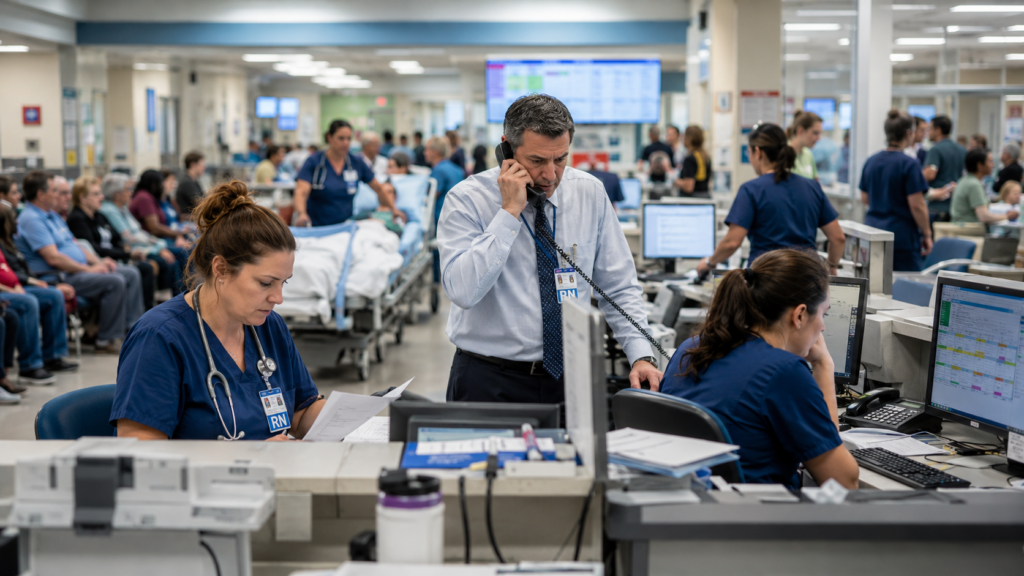
Emergency room wait times are easy to blame on the ER. Patients arrive, the waiting room fills, staff move quickly, and frustration builds. From the outside, it looks like the emergency department is the problem.
That is usually too simple.
In many hospitals, long ER wait times are not only an emergency room issue. They are a visible sign that the entire hospital is struggling to move patients through the system. Staffing gaps, delayed discharges, unavailable inpatient beds, administrative bottlenecks, transport delays, and unpredictable patient volume can all show up first in the emergency department.
That is why healthcare leaders should look beyond the waiting room when evaluating ER pressure. StaffDash provides healthcare staffing solutions that help facilities think through clinical, non-clinical, temporary, and workforce management needs across the care environment. StaffDash’s services include emergency room staffing, EMS staffing, onsite staffing management, clinicians staffing, non-clinicians staffing, medical staff, and remote U.S.-licensed RN support.
Direct Answer: ER wait times are often longer when the hospital cannot move patients through the full care pathway. The emergency room feels the pressure first, but the root cause may include inpatient bed delays, nurse coverage gaps, discharge bottlenecks, transport limitations, and administrative workload across the facility.
The ER Is the Front Door, Not the Whole Building
The emergency room is where hospital pressure becomes visible.
When patients arrive faster than they can be evaluated, treated, admitted, transferred, or discharged, the ER becomes crowded. But that crowding does not always start inside the emergency department.
A patient may be ready for admission, but no inpatient bed is available. Another patient may need imaging, labs, specialist review, or transport. A discharge may be delayed because paperwork, case management, environmental services, or care coordination is backed up. A nurse may be covering too many competing priorities because staffing has not kept pace with patient volume.
The result is simple: patients stay in the ER longer than expected.
The CDC reported 155.4 million emergency department visits in the United States, with 17.8 million visits resulting in hospital admission and 3.1 million resulting in admission to a critical care unit. That volume shows why emergency departments are not isolated units; they are deeply connected to inpatient capacity, staffing availability, and hospital-wide patient flow.
Why Boarding Creates Pressure Inside the ER
One of the biggest drivers of ER pressure is boarding.
Boarding happens when a patient has already received initial emergency care and is waiting for an inpatient bed or transfer. The patient remains in the emergency department even though the next step in care should happen somewhere else.
ACEP describes boarding as a result of health system overload, where patients are placed in a holding pattern while waiting for an inpatient bed or transfer after initial care. ACEP also notes that staffing challenges and burnout worsen the boarding crisis.
This matters because boarding affects more than space. It affects staff attention, room turnover, nurse workload, physician workflow, patient communication, and the ability to evaluate new arrivals quickly.
The CDC found that emergency departments with any boarding had longer wait times than those without boarding. In the cited data, wait time in EDs with boarding was 61.3 minutes compared with 44.1 minutes in EDs with no boarding.
That does not mean staffing is the only cause of boarding. It means staffing is one of the operational levers hospital leaders should evaluate when boarding, crowding, and wait times become persistent.
The Staffing Domino Effect Behind ER Wait Times
ER wait times can stretch when one part of the hospital workforce is unstable.
- The ER receives more patients than expected.
- Nurses, physicians, technicians, or support staff are stretched.
- Patients who need admission cannot move quickly because inpatient capacity is constrained.
- Discharge planning or bed turnover slows down.
- Administrative and documentation tasks pile up.
- New patients wait longer to be triaged, roomed, or updated.
- Staff fatigue increases.
- The ER becomes the holding area for system-wide delays.
This is why solving ER pressure requires more than asking the emergency department team to “work faster.” That is not a real strategy. It is a shortcut, and a dangerous one if leaders ignore the larger workflow.
StaffDash’s emergency room staffing support is positioned for facilities that need experienced emergency professionals and flexible staffing options to support urgent care and operational needs. The StaffDash ER staffing page also discusses flexible staffing solutions that can scale with patient volume and unexpected demand.
Clinical Staffing Gaps Are Only One Part of the Problem
When hospitals discuss ER staffing, the conversation usually starts with clinicians. That makes sense. Emergency physicians, nurses, nurse practitioners, physician assistants, technicians, paramedics, CNAs, and other clinical workers are central to emergency care operations.
But clinical coverage alone does not solve every workflow problem.
Even when the clinical team is strong, patient flow can slow if the rest of the hospital support structure is under-resourced. A hospital may need more help with scheduling, patient access, insurance verification, unit coordination, transport coordination, documentation support, or other administrative functions.
Non-Clinical Bottlenecks Can Still Affect Patient Flow
This is where many hospitals make costly mistakes.
They treat ER wait times as a purely clinical staffing issue. Then they overlook the administrative and operational roles that keep patients moving.
Non-clinical team members do not diagnose, prescribe, or treat patients, but they often support the systems that make care delivery possible. Reception, patient access, insurance verification, billing, coding, HR, IT, coordination, and administrative support can all affect the speed and clarity of the patient journey.
StaffDash’s service page describes non-clinicians as behind-the-scenes healthcare workers such as medical billers and coders, transcriptionists, hospital executives, receptionists, administrators, IT, and HR support.
For example:
StaffDash’s medical staff support can help facilities think beyond isolated shift coverage and look at broader staffing needs for hospitals and emergency rooms. StaffDash’s medical staff page describes its support for hospitals and emergency rooms and emphasizes the challenges involved in meeting staffing needs in those settings.
That is why non-clinical staffing support belongs in the conversation when hospital leaders are evaluating patient-flow problems.
- If registration is backed up, patients may wait longer before being fully processed.
- If discharge paperwork is delayed, beds may not open quickly.
- If unit coordination is thin, internal communication may slow down.
- If billing or documentation support is under pressure, administrative workload may spill back onto clinical teams.
- If scheduling support is weak, staffing coverage may become reactive instead of planned.
The ER may be where patients feel the delay, but the delay may have started somewhere else.
Why Temporary and Flexible Staffing Should Be Planned Before the Crisis
Temporary staffing should not be treated only as a last-minute emergency button.
That is another weak strategy.
When hospitals wait until the ER is overwhelmed, staffing choices become rushed. Leaders may have fewer options, less time for onboarding, more pressure on existing staff, and less control over schedule quality.
A stronger approach is to plan flexible staffing before the system is under visible strain.
That may include:
- Per diem support for predictable demand shifts
- Temporary staffing during seasonal spikes
- Temp-to-permanent staffing when long-term gaps are emerging
- On-call or surge coverage planning
- Backup support for hard-to-fill roles
- Non-clinical staffing to reduce administrative burden on clinical teams
The American Hospital Association states that hospitals are facing rising demand, workforce exhaustion, burnout, vacancies, administrative burden, and financial pressure. AHA also notes that hospitals are shifting from crisis management to long-term workforce redesign, including new staffing models, cross-training, remote or hybrid clinical roles, mobile workforce pools, retention, and workforce resilience.
That is the direction healthcare leaders should be moving toward: not panic staffing, but resilient staffing.
How Onsite Staffing Management Supports Hospital-Wide Workforce Control
For some healthcare facilities, the staffing problem is not only about filling individual shifts. It is about managing the system.
That is where onsite staffing management becomes valuable.
An onsite staffing partner can help coordinate hiring, onboarding, scheduling, attendance visibility, compliance tracking, workforce reporting, and day-to-day staffing support. StaffDash describes its onsite staffing management service as a dedicated workforce management partner located directly at the facility, acting as an extension of HR and recruitment. The service includes high-volume hiring, workforce oversight, scheduling, compliance and credential management, onboarding, and workforce reporting.
For hospitals dealing with recurring ER pressure, onsite staffing management can help shift the conversation from “Who can cover tomorrow?” to “How do we build a more stable coverage model?”
That is the better question.
What Hospital Leaders Should Review When ER Wait Times Keep Rising
When ER wait times become a recurring issue, leaders should not stop at the emergency department schedule.
A practical review should include:
1. Patient Arrival Patterns
Look at the busiest days, hours, seasonal trends, and predictable surges. Staffing models should reflect real demand patterns, not old assumptions.
2. Boarding and Bed Availability
Measure how long admitted patients remain in the ER while waiting for inpatient beds. If admitted patients are staying in the ER too long, the bottleneck may be inpatient capacity, discharge timing, or bed turnover.
3. Nurse and Clinical Support Coverage
Review nurse-to-patient workload, technician support, provider coverage, triage coverage, and role clarity during peak hours.
4. Non-Clinical Support
Evaluate registration, patient access, unit coordination, documentation support, discharge coordination, and administrative coverage.
5. Discharge Flow
Delayed discharges affect bed availability, and bed availability affects ER movement. Discharge planning is a hospital-wide issue, not only an inpatient issue.
6. Scheduling Flexibility
Rigid staffing models struggle when demand shifts quickly. Leaders should review whether the facility has enough flexible staffing options for predictable and unpredictable pressure.
7. Workforce Retention Risk
Repeated short-staffing can contribute to burnout, morale issues, and turnover risk. This should be treated as an operational warning sign, not just an HR concern.
BLS projects registered nurse employment to grow 5% from 2024 to 2034 and estimates about 189,100 RN openings per year on average over the decade. That projection reinforces why hospitals need stronger workforce planning instead of relying only on last-minute recruiting.
Key Takeaway
ER wait times are not always caused by a weak emergency department. Often, they are a warning sign that the hospital’s staffing model, patient-flow process, inpatient capacity, discharge system, or administrative support structure is under strain.
The ER is where the pressure becomes visible. The staffing problem may be much bigger.
Healthcare leaders should evaluate the full workforce picture: clinical staff, non-clinical staff, temporary coverage, onsite management, scheduling flexibility, and patient-flow coordination.
When to Contact StaffDash
Contact StaffDash when your facility is seeing repeated staffing instability, rising ER pressure, hard-to-fill shifts, unpredictable patient volume, delayed coverage, or administrative strain that affects patient flow.
StaffDash can support healthcare facilities with staffing services across emergency rooms, medical staff, clinicians, non-clinicians, EMS, event medical staffing, remote U.S.-licensed RNs, and onsite staffing management. The goal is not to promise instant fixes. The goal is to help healthcare leaders build a more responsive staffing plan before pressure becomes harder to manage.