
Remote U.S. Licensed RNs
Expand Your Clinical Capacity with Remote U.S. State Licensed Registered Nurse

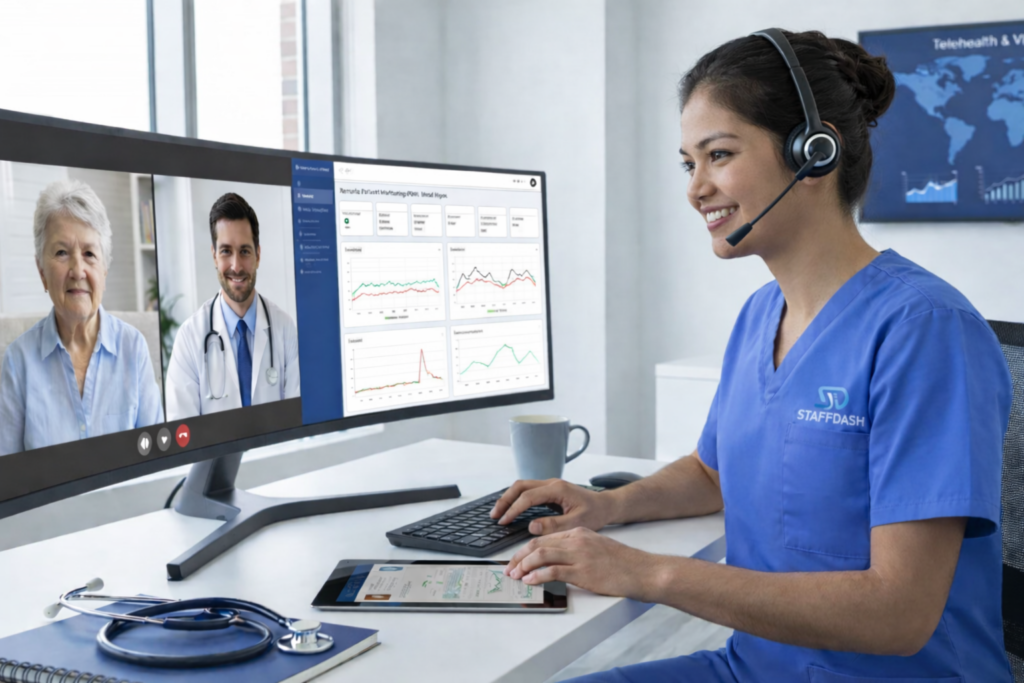


Comprehensive Remote Nursing Capabilities
Our Remote U.S. State licensed RNs possess the clinical judgment and technical proficiency to handle a vast array of healthcare functions from a virtual environment. Partnering with StaffDash allows you to fill critical roles across the following specialties and tasks:
- Telehealth & Virtual Care: Conducting comprehensive virtual patient assessments, facilitating e-visits alongside physicians, and managing Remote Patient Monitoring (RPM) data.
- Telephone Triage: Serving as the clinical first point of contact to evaluate patient symptoms, provide evidence-based medical advice, and direct patients to the appropriate level of urgent or routine care.
- Case Management & Care Coordination: Overseeing long-term care plans, coordinating services among multiple providers, and guiding patients through chronic illness management or post-discharge recovery.
- Utilization Review & Management: Analyzing medical records and treatment plans to ensure clinical necessity, cost-effectiveness, and alignment with insurance coverage guidelines.
- Prior Authorization: Reviewing and processing complex requests for medications, procedures, and specialist visits to minimize delays in patient care.
- Clinical Documentation Integrity (CDI): Performing concurrent chart reviews to ensure provider documentation is highly accurate, complete, and compliant for proper coding and billing.
- Quality Assurance & Compliance: Evaluating organizational nursing practices, reviewing clinical data, and auditing processes to ensure strict adherence to healthcare regulations and HIPAA standards.
- Health Informatics: Leveraging clinical expertise to implement, optimize, and troubleshoot Electronic Health Record (EHR) systems and other digital healthcare technologies.
- Clinical Research Coordination: Overseeing clinical trials remotely by gathering study data, monitoring participant safety, and preparing essential regulatory documentation.
- Legal Nurse Consulting: Assisting risk management teams, insurance adjusters, or legal counsel by interpreting complex medical records and assessing standards of care.
- Nurse Health Coaching: Empowering patients through individualized, virtual coaching sessions focused on lifestyle modifications, medication adherence, and preventative care.
- Medical Writing & Education: Developing robust patient education materials, clinical training curricula, and health-related communications for your organization’s internal or external use.
Why Choose StaffDash for Your Remote Staffing Needs?
- Rigorous Vetting: Every RN in our network undergoes comprehensive background checks, thorough credential verification, and active license confirmation (including compact state verification).
- Tailored Matching: We align our nursing candidates not just with your clinical requirements, but with your organization’s specific software platforms and workflow processes.
- Cost Efficiency: Reduce overhead costs associated with on-site staff for work that can be done remotely while maintaining the highest standard of patient care and administrative excellence. StaffDash can save our community employers at least 50% of the payroll cost by choosing to hire U.S State licensed RN through us. An average U.S State Licensed remote RN hired through StaffDash will cost our client $25.00/hour (all inclusive rate). The RN will be dedicated to the client and can work either full time or part time.
- Guaranteed Payroll Savings that can exceed 50%. Guaranteed Productivity.
Frequently Asked Question
Remote RN staffing is a service that provides licensed U.S. Registered Nurses who perform clinical tasks virtually, including telephone triage, care coordination, remote patient monitoring, utilization review, and prior authorization support.
Remote RN staffing typically involves onboarding licensed nurses into your existing workflows, EHR systems, and communication platforms. After credentialing and orientation, RNs begin handling assigned clinical tasks under defined protocols and reporting structures.
Yes. All RNs hold active U.S. state licenses and meet applicable regulatory and credentialing standards before placement.
Licenses are verified through official state nursing boards, Nursys database checks, and routine re-verification processes to ensure ongoing compliance.
Remote RN staffing must operate within HIPAA guidelines. This includes secure system access, encrypted communication channels, access controls, and confidentiality agreements.
Yes. Remote RNs can conduct symptom assessment, provide evidence-based guidance, escalate urgent cases, and document encounters according to your protocols.
Yes. Remote RNs can provide extended-hours or after-hours coverage to reduce on-site staffing burden and improve patient access.
Onboarding timelines vary but typically depend on credentialing requirements, workflow integration, and system access approvals.
Yes. Remote RNs can monitor incoming patient data, conduct follow-up calls, document interventions, and escalate abnormal readings under defined care protocols.
Yes. Remote RNs can coordinate between providers, follow up with patients, manage referrals, and assist with discharge planning processes.
Yes. Remote RNs can assist with clinical documentation review, medical necessity evaluation support, and case documentation under payer or provider guidelines.
Remote RN can help with every aspect of the prior authorization process, from preparing documentation, coordinating with providers, and following up on authorization requests according to the established workflows.
Remote RNs can adapt to most major EHR systems and telehealth platforms following access setup and workflow training.
Quality control may include performance monitoring, clinical audits, documentation reviews, and defined reporting metrics aligned with client requirements.
Remote RN staffing can reduce overhead associated with full-time hiring, benefits, recruitment costs, and physical workspace requirements. Actual cost savings vary by role and coverage model. It reduces burnout caused by minor bottle neck processes, etc.
Remote staffing provides scalable capacity without long-term employment commitments, allowing organizations to adjust coverage based on operational demand.
Confidentiality is maintained through secure system access, HIPAA-aligned policies, restricted access controls, and documented compliance procedures.
Yes. Staffing levels can be adjusted based on operational needs, campaign surges, or program expansion.
Organizations typically consider outsourcing when experiencing staffing shortages, patient backlog, delayed authorizations, expansion into telehealth, or increased RPM enrollment.
Key factors include license verification processes, HIPAA compliance experience and measures, onboarding timelines, QA systems experience, communication structure, and specialty experience.
Yes. Remote RNs can support small practices that need flexible clinical support without hiring full-time in-house staff.
Improvement timelines depend on workload, workflow design, and escalation protocols, but structured deployment can reduce backlog pressure.
Common areas include telehealth triage, chronic care management, remote patient monitoring, utilization review, prior authorization, care coordination, and discharge follow-up.
Remote RNs operate within state scope-of-practice regulations and clinical governance structures defined by the hiring organization.
Yes. Remote RNs are trained to document encounters in accordance with clinical, legal, and compliance requirements.